Kentucky clinical hours in Sacred Heart University's NP programs
Short version: Kentucky works. Sacred Heart University's September 2026 disclosures list Kentucky as "Yes" for every FNP and PMHNP program, and the Kentucky Board of Nursing (KBN) tells schools based elsewhere that its approval is unnecessary, even for a Kentucky rotation. The Kentucky details worth your attention concern licenses: yours, and the one your preceptor carries.
Get your placement plan
Tell us your Sacred Heart program and where you live. A placement advisor replies with the preceptor and site options that fit your course.
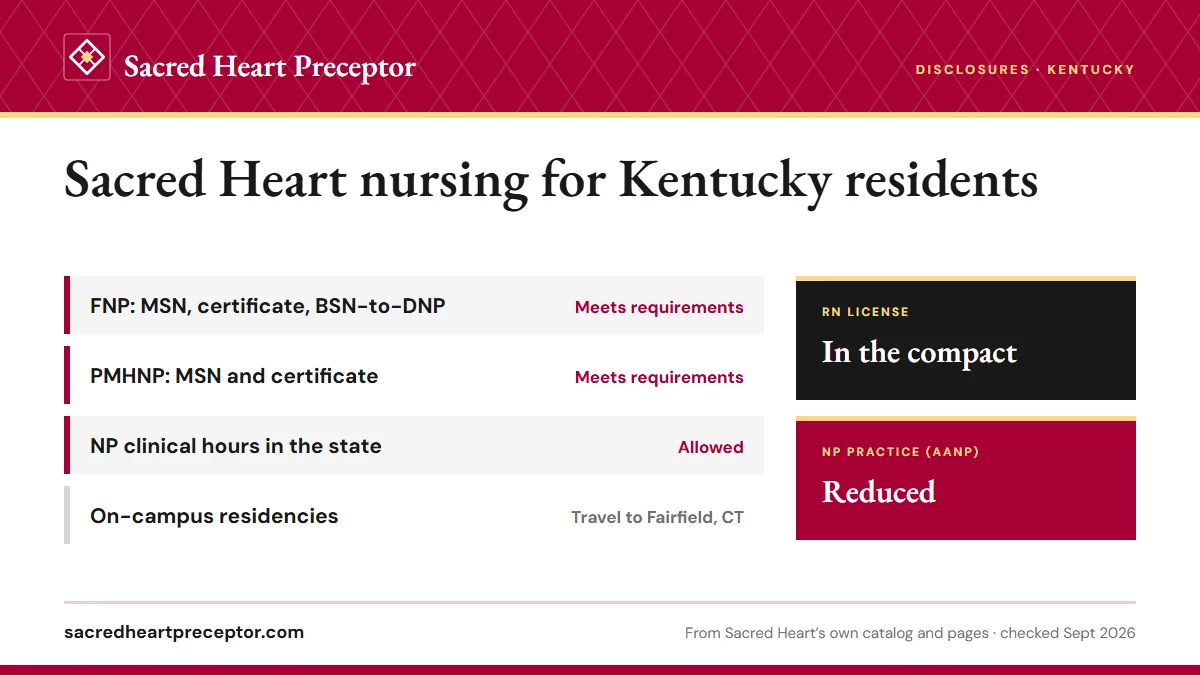
Kentucky's disclosure rows
Here is how Sacred Heart answered for Kentucky in September 2026. The question behind each row is whether the program meets Kentucky's educational requirements for licensure or certification. Before enrolling or moving, recheck the row; Sacred Heart's catalog leaves that confirmation with you.
| Program | Kentucky | Delivery | Hours |
|---|---|---|---|
| MSN FNP | Yes | Online, clinicals in person | 540 |
| FNP certificate (post-master's) | Yes | Online, clinicals in person | 540 |
| BSN-to-DNP (FNP) | Yes | Hybrid | 1,000 minimum per guide |
| MSN PMHNP | Yes | Online, clinicals in person | 540 |
| PMHNP certificate (post-master's) | Yes | Online, clinicals in person | 540 |
| MSN Clinical Nurse Leader | Yes | Online | 420 or 400/500, by source |
The whole table, "No" states included, is summarized on our disclosures page.
KBN draws its line narrowly
KBN's authority over schools covers prelicensure programs that start in Kentucky. A nursing school headquartered in another state, even one whose only Kentucky footprint is a student's rotation, sits outside that approval system, and KBN says so plainly on its out-of-state programs page. RN-BSN completion programs are beyond KBN's reach, while graduate programs that lead to licensure fall within its jurisdiction.
For you, that means no state filing waits between your preceptor's yes and your first shift. What remains is Sacred Heart's own sequence, from your advisor's sign-off to a signed affiliation agreement, and a new site's agreement alone can run nine months. The clinical placement process page follows it end to end.
The SARA exemption and Sacred Heart's own license rule
Kentucky's board also cites KRS 314.101, which excuses nurses from other states from Kentucky licensure during clinical rotations, provided their school participates in SARA or holds a license from the Kentucky Council on Postsecondary Education. Sacred Heart's SARA participation dates from January 11, 2017.
Sacred Heart's guide, though, sets its own bar: a current, unencumbered license for each state in which you practice clinically, on file in the Health Account. Kentucky has honored the compact since January 19, 2018, and any member state's multistate card reaches Kentucky clinics. If yours is single-state from elsewhere, ask Sacred Heart whether the exemption satisfies its rule before you count on it. See the RN license guide.
A Kentucky statutory exemption is not the same thing as Sacred Heart's license requirement. Get Sacred Heart's answer in writing before relying on it.
What Kentucky asks of your preceptor
KBN's guidance for online APRN programs covers the people supervising you. A nurse who precepts or oversees students at a Kentucky site needs an active Kentucky APRN license without encumbrances; one living outside the compact also needs Kentucky RN licensure. A Kentucky-based APRN will normally meet that already.
AANP classes Kentucky as reduced practice. Unless the Board grants an exemption, Kentucky NPs who prescribe hold two physician agreements, one covering scheduled drugs and one covering the rest, and newly licensed NPs face employer-setting limits in their first year. Sacred Heart's one-year experience floor already rules out most first-year Kentucky NPs. Full criteria: preceptor requirements.
Louisville, Lexington, the Cincinnati suburbs and Bowling Green
The 2025 Census estimates break Kentucky's larger markets down like this:
- Louisville/Jefferson County: about 1.12 million Kentucky residents
- Lexington-Fayette: about 535,000
- Northern Kentucky, within the Cincinnati metro: about 475,000
- Bowling Green: about 197,000
Norton Healthcare, Baptist Health (Kentucky and southern Indiana), UK HealthCare, UofL Health and St. Elizabeth Healthcare are systems Kentucky NP students contact. Each makes its own decisions about students, and none has promised Sacred Heart a slot. Southern Indiana sits inside the Louisville metro too; see our Indiana guide.
Why Kentucky students choose us
We search Kentucky for APRNs and physicians who fit your Sacred Heart course, confirm the preceptor's Kentucky licensure up front, and hand Sacred Heart a complete approval packet with the name of the site's contract contact filled in. Lose a preceptor mid-course and a fresh Kentucky search opens the same day. Reach us through the contact page.
Questions Sacred Heart students ask
Does KBN need to approve Sacred Heart's program before I train in Kentucky?
No. KBN states that nursing programs from other states are not required to hold its approval, and a rotation in Kentucky does not change that. Sacred Heart's advisor and its MSN Online NP Programs Clinical Coordinator do the approving, and the site signs an affiliation agreement with Sacred Heart.
Can I train in Kentucky on the KRS 314.101 exemption instead of a Kentucky license?
Kentucky's law may allow it, since Sacred Heart is a SARA institution. Sacred Heart's guide still requires a license in each clinical state, and the Health Account asks for it. Holding a multistate card makes the question moot; otherwise ask Sacred Heart first.
Can a northern Kentucky resident train at a Cincinnati practice?
Ohio's compact membership began January 1, 2023, which lets a Kentucky-issued multistate card cover an Ohio practice. Ohio also reads "Yes" on Sacred Heart's table as of September 2026. Check Ohio's own rules for out-of-state programs on our Ohio guide before you commit.
Can a newly licensed Kentucky NP be my preceptor?
Usually not. Sacred Heart wants a year or more of hands-on experience from any preceptor (primary care for FNP, psychiatric care for PMHNP), and Kentucky's first-year NPs also work under employer-setting limits. Someone further along is the safer choice.
Related pages
Last checked 2026-09-25
We check these pages against Sacred Heart's own catalog, program pages and 2026-27 student guides. Your student guide, your academic advisor and your course faculty have the final word.
Sacred Heart asks you to secure your clinical placement. We make that the easy part.
Tell us your Sacred Heart program, your city and your next clinical course. We find preceptors who fit the course and prepare what your advisor, the NP clinical coordinator and the Contract Request Form ask for, early enough for the affiliation agreement.
- Preceptors matched to the course: primary care of adults, women and children for FNP, psychiatric care across the lifespan for PMHNP
- Preceptor CV, license, board certification and the site's contract contact ready before your week-10 deadline
- Close to home in any state where Sacred Heart's program meets licensure requirements, with New York's rule planned around
Start your placement plan
Program, city and clinical start is all we need to begin.