Sacred Heart's licensure disclosures for every state
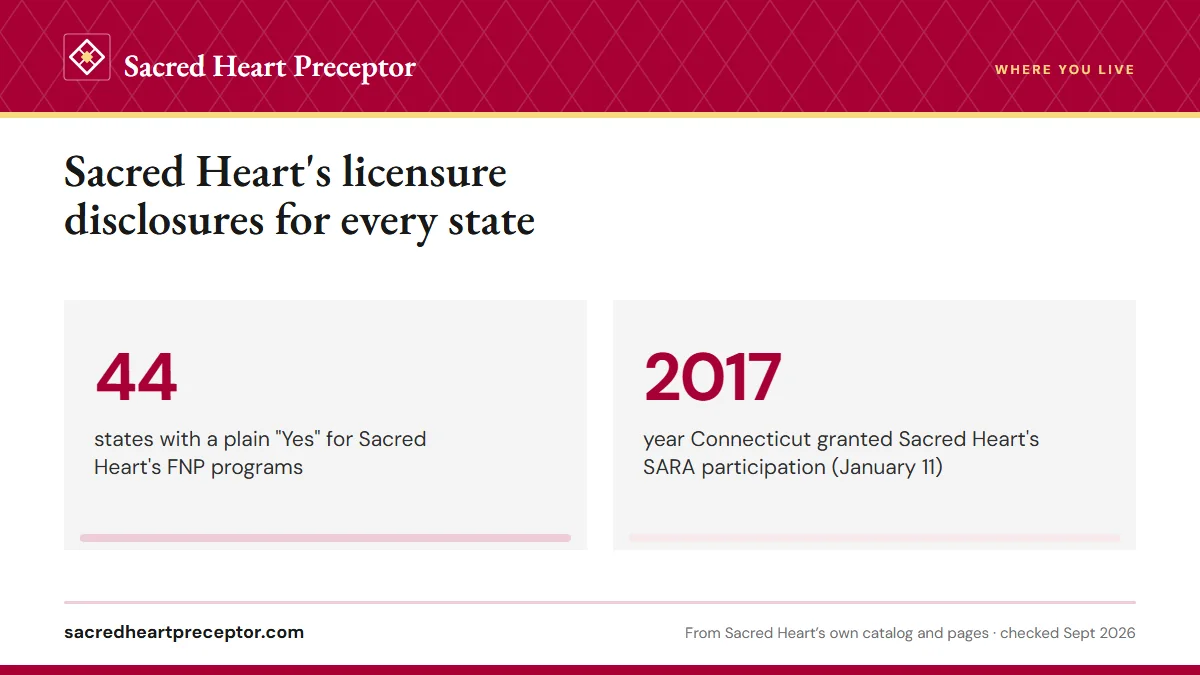
For each state and territory, Sacred Heart University answers one question per program: does it meet the educational requirements for licensure or certification there? As of September 2026 the FNP programs read a plain "Yes" in 44 states, New York reads "Yes" with a clinical condition, and Arizona, California, the District of Columbia, Kansas, Louisiana, Oregon and the territories read "No". The PMHNP programs add Washington to that "No" list.
Check your state, then start the search
Tell us where you live and your next clinical course; we search preceptors in your own state.
What the disclosure table answers
The table lives on Sacred Heart University's State Authorization, Disclosures & Student Complaints page, in an accordion titled "Licensure & Disclosures by State." Each program row in a state shows the program, the regulatory board, the column "Does program meet the educational requirements for licensure/certification?" and a box for additional considerations, and every state ends with a complaint link for its agency.
A "Yes" settles the education question and nothing more. Your license still comes from the state's board once you graduate and pass certification, and a "Yes" says nothing about how many preceptors practice there. A "No" means Sacred Heart does not claim the match for that state.
Rows are grouped by the license a program leads to: FNP licensure (the MSN FNP, the BSN-to-DNP FNP and the post-master's FNP certificate), PMHNP licensure (the MSN PMHNP and the post-master's PMHNP certificate), the MSN Clinical Nurse Leader, and the campus RN licensure programs.
FNP and PMHNP answers for every state and territory
Here is the table as captured on September 25, 2026, grouped by answer. Sacred Heart can revise the live page, so reread your own row there before you enroll and before any move.
| Answer | FNP programs (MSN FNP, BSN-to-DNP FNP, post-master's FNP certificate) | PMHNP programs (MSN PMHNP, post-master's PMHNP certificate) |
|---|---|---|
| Yes | Alabama, Alaska, Arkansas, Colorado, Connecticut, Delaware, Florida, Georgia, Hawaii, Idaho, Illinois, Indiana, Iowa, Kentucky, Maine, Maryland, Massachusetts, Michigan, Minnesota, Mississippi, Missouri, Montana, Nebraska, Nevada, New Hampshire, New Jersey, New Mexico, North Carolina, North Dakota, Ohio, Oklahoma, Pennsylvania, Rhode Island, South Carolina, South Dakota, Tennessee, Texas, Utah, Vermont, Virginia, Washington, West Virginia, Wisconsin, Wyoming (44) | The same states except Washington (43) |
| Yes, with a condition | New York: no clinical work may take place in the state | New York: no clinical work may take place in the state |
| No (states and DC) | Arizona, California, District of Columbia, Kansas, Louisiana, Oregon | Arizona, California, District of Columbia, Kansas, Louisiana, Oregon, Washington |
| No (territories) | American Samoa, Federated States of Micronesia, Guam, Northern Mariana Islands, Puerto Rico, Republic of Palau, Republic of the Marshall Islands, U.S. Virgin Islands | The same eight territories |
Sacred Heart's preceptor portal singles out four of the "Yes" states, Connecticut, New Jersey, Massachusetts and Rhode Island, as places with particular need for preceptors. Our state guides cover each state's board and compact status.
Washington and New York: two rows to read twice
Washington is the one state where the two NP families part ways. Its FNP row reads "Yes" and its PMHNP row reads "No", so a Washington resident weighing the PMHNP should not assume the education requirements are met there. The main column gives no reason for the split; look at the additional-considerations box on Sacred Heart's page and at the Washington board's own rules, and the Washington guide has both.
New York reads "Yes" for both families, but with strings attached: enrolling means agreeing to do every clinical hour outside New York. That condition decides where New York residents train and which license they carry, so it gets a full page of its own, the New York clinical rule.
The Clinical Nurse Leader row and the RN licensure programs
The online MSN Clinical Nurse Leader reads "Yes" in every state, with a clarification attached: the specialization "is not equivalent and does not meet the requirements for 'Certified Clinical Nurse Specialist'." A CNL is its own credential, and the disclosure keeps the two apart. Louisiana residents may enroll, but that row adds that students in Louisiana may not complete any clinical work in the state, so the practicum hours of NU 611, NU 612, NU 680 and NU 681 happen across a state line. The territories read "No".
Sacred Heart also discloses its campus RN licensure programs, the ASN and the BSN, which prepare graduates for a first nursing license. They sit outside this site's focus and appear here for completeness; the campus BSN clinicals page explains how the school schedules those students.
| Answer | Jurisdictions |
|---|---|
| No | Hawaii and the territories |
| Yes, with extra notes (marked Yes*) | District of Columbia, Oklahoma, Tennessee, Washington (notes on physics or clinical hours) |
| Yes | The remaining states |
SARA, California and a wording conflict
Sacred Heart belongs to the National Council for State Authorization Reciprocity Agreements (NC-SARA). The Connecticut Office of Higher Education granted its SARA participation on January 11, 2017, and Sacred Heart says it has been maintained every year since. Membership authorizes Sacred Heart to offer distance programs in each state and U.S. territory that takes part in SARA.
California stands apart. Sacred Heart notes that California is the only state outside SARA and that, as a non-profit, the university is exempt from approval by the California Bureau of Post-Secondary Education. That exemption concerns operating in California; the licensure answer in California's FNP and PMHNP rows remains "No".
Sacred Heart also states that SARA participation does not relieve its programs of state licensing and certification requirements. That explains a conflict on its own pages: the nursing disclosures page calls the online MSN FNP and PMHNP and the post-master's certificates authorized in all SARA states, yet the state table marks them "No" in six jurisdictions, seven for PMHNP. The disclosures page itself says the university does not offer its degree programs in every state and points to the State Authorization page for the exceptions, so treat the table as the governing detail and ask admissions or your academic advisor when the two seem to disagree.
Checking your own state, and moving mid-program
Sacred Heart's graduate catalog puts the last check with you: "Students are responsible to verify the status of state authorization and Board of Nursing or equivalent approval in their state of residence." Read your row on the live page, then read your own board's rules for graduates of out-of-state programs.
A move reopens all of it. Sacred Heart asks students who relocate to revisit the page and file a change of address form, and warns that skipping the check can leave a student unable to obtain clinical placements in the new state. Moving from a "Yes" state into one of the "No" jurisdictions changes the licensure answer where you will live; moving between "Yes" states still usually means a new RN license and a new site.
Before you enroll or relocate
- Open your own program's row (FNP, PMHNP or CNL) on Sacred Heart's live page, not a saved copy.
- Read the additional-considerations box, where conditions such as New York's and Louisiana's appear.
- Look up the state board's rules for licensing graduates of out-of-state programs.
- Confirm you hold, or can obtain, an RN license where you will train (RN license for clinicals).
- Moving mid-program? See clinicals outside Connecticut.
A "Yes" for your state is not a list of sites: online students still identify their own preceptor and site there, and a site new to Sacred Heart needs an affiliation agreement first.
Why students in every "Yes" state search with us
The disclosure table shows where the degree counts. We make the clinical side work where you actually live. Our search runs across the 44 "Yes" states and in the neighboring states where New York residents train, and it starts from the course in front of you: adult and family primary care for NU 561 and NU 621, children for NU 606, women's health for NU 607, psychiatric settings for NU 571 through NU 573.
Every preceptor we bring forward comes with the CV, license and board certification the MSN Online NP Programs Clinical Coordinator reviews, plus the site's contract contact for the Contract Request Form. Share your state and next clinical course in the form below to begin.
Questions Sacred Heart students ask
Does Sacred Heart's online FNP meet licensure requirements in my state?
On Sacred Heart's disclosure table, 44 states read a plain "Yes" for the FNP programs and New York reads "Yes" on condition that no clinical work happens there. Arizona, California, the District of Columbia, Kansas, Louisiana, Oregon and the U.S. territories read "No". Check your row on the live page before enrolling, since Sacred Heart can update it.
Why is Washington "No" for the PMHNP but "Yes" for the FNP?
The answer column gives the result without the reasoning. The split affects only the PMHNP programs, the MSN PMHNP and the post-master's PMHNP certificate. Read Washington's additional-considerations box on Sacred Heart's page and the Washington board's rules, and raise it with admissions or your academic advisor before enrolling in the PMHNP from Washington.
Can I enroll from a state marked "No"?
The table answers whether the program meets that state's educational requirements; whether Sacred Heart admits residents of a given state is an admissions question. Sacred Heart's disclosures page says it does not offer its degree programs in every state and sends readers to the State Authorization page for the exceptions, so ask admissions directly and keep the reply.
Is Sacred Heart's Clinical Nurse Leader the same as a clinical nurse specialist?
No. Sacred Heart draws that line in the disclosure itself: its CNL specialization does not meet the requirements for the Certified Clinical Nurse Specialist credential and is not its equivalent. The CNL row reads "Yes" in every state for what the program is, a CNL program, and Louisiana residents in it complete their clinical work outside Louisiana.
What should I do if I move to another state during the program?
Open the new state's row first, then file the change of address form Sacred Heart requires. Plan on a new RN license, a new site and possibly a new affiliation agreement, which can take up to nine months for a site Sacred Heart has not contracted with. The earlier Clinical Placement hears about the move, the more time you keep.
Related pages
Last checked 2026-09-25
We check these pages against Sacred Heart's own catalog, program pages and 2026-27 student guides. Your student guide, your academic advisor and your course faculty have the final word.
- Sacred Heart University, State Authorization, Disclosures & Student Complaints
- Sacred Heart University College of Nursing, Nursing Licensure & Certification Disclosures
- Sacred Heart University Online, State Authorizations
- Sacred Heart University 2026-2027 Graduate Catalog, Master of Science in Nursing
- Sacred Heart University, Preceptor Portal - APRN Programs
Sacred Heart asks you to secure your clinical placement. We make that the easy part.
Tell us your Sacred Heart program, your city and your next clinical course. We find preceptors who fit the course and prepare what your advisor, the NP clinical coordinator and the Contract Request Form ask for, early enough for the affiliation agreement.
- Preceptors matched to the course: primary care of adults, women and children for FNP, psychiatric care across the lifespan for PMHNP
- Preceptor CV, license, board certification and the site's contract contact ready before your week-10 deadline
- Close to home in any state where Sacred Heart's program meets licensure requirements, with New York's rule planned around
Start your placement plan
Program, city and clinical start is all we need to begin.