The RN license behind every Sacred Heart clinical hour
Wherever a Sacred Heart University student logs clinical hours, that state has to recognize the student's RN license, and the license must be active and carry no encumbrance. One multistate license can cover several states through the Nurse Licensure Compact, which Connecticut joined on October 1, 2025. Massachusetts has not put the compact into effect and New York is not a member, so training in Massachusetts, or training anywhere as a New York resident, means holding a license from that state's own board.
Search where your license works
Tell us which states license you; we search preceptors inside that map.
The rule and where Sacred Heart checks it
The MSN and post-MSN certificate guide puts it in one sentence: "All nursing students must have a current active unencumbered nursing license in the state(s) in which they are doing a clinical practice." The plural matters. A student who splits NU 606 and NU 607 between practices in two states needs a license valid in both.
Sacred Heart checks it in three places. At admission, MSN applicants submit a current unencumbered U.S. RN license from their home state plus the license for their state of practice, and certificate and post-master's DNP applicants show an RN license in their state of residence. During the program, your Health Account carries an item named "RN Licensure of the state where you are completing clinical." And before any clinical day, the Cleared for Clinical email waits on full compliance with every Student Practice Requirement, the license included.
The license has to stay current the whole way. MSN FNP and PMHNP students must be compliant by week 10 of NU 552 and for the rest of the program, so a renewal that lapses mid-course is a compliance problem, not a paperwork detail. The Health Account page covers the other items that travel with it.
One license, several states: the Nurse Licensure Compact
Only RN and LPN licenses fall under the compact. A nurse whose primary residence is in a member state can hold a multistate license there and practice in the other member states on it. Your future APRN license sits outside it: just five states have passed the separate APRN Compact, which cannot operate until seven join. For clinicals, your RN license is the one Sacred Heart asks about.
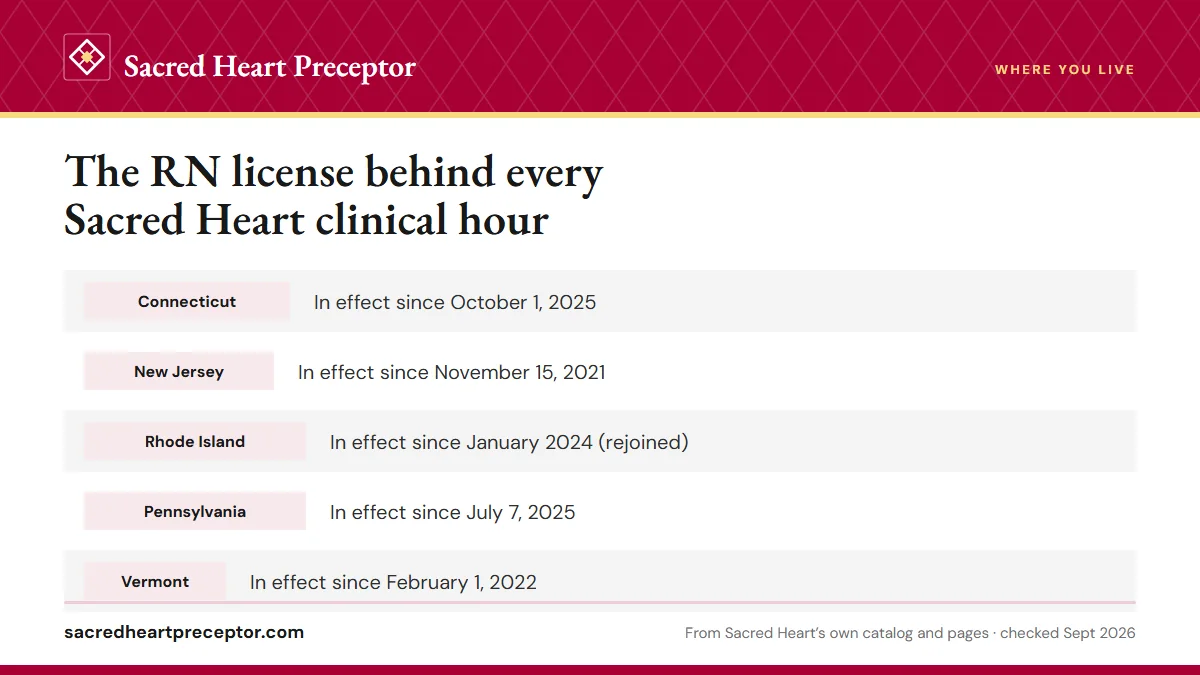
Here is where the states near Sacred Heart stand, from each board's records and the compact's implementation table.
| State | Compact status | License for a clinical there |
|---|---|---|
| Connecticut | In effect since October 1, 2025 | Connecticut license, or a multistate license from your compact home state |
| New Jersey | In effect since November 15, 2021 | New Jersey license or a multistate license |
| Rhode Island | In effect since January 2024 (rejoined) | Rhode Island license or a multistate license |
| Pennsylvania | In effect since July 7, 2025 | Pennsylvania license or a multistate license (see the student provision below) |
| Vermont | In effect since February 1, 2022 | Vermont license or a multistate license |
| Massachusetts | Enacted November 2024; the board targets May 2027 to put it into effect | Massachusetts license until the compact takes effect |
| New York | Not a member; no pending compact legislation | NP clinicals at Sacred Heart happen outside New York |
A multistate license does not reach Massachusetts yet: until the compact takes effect there, a Massachusetts clinical site needs a Massachusetts RN license.
Connecticut's compact start, and the 2028 date in the statute
Connecticut's Department of Public Health announced that the state implemented its compact participation effective October 1, 2025. Since then, Connecticut-resident RNs can convert to a multistate license, which DPH describes as recognized across state lines in the compact's member states and territories. Licensees manage the change through their account at elicense.ct.gov.
For a Connecticut resident, that one license can open clinicals in New Jersey, Rhode Island, Pennsylvania and Vermont, while Massachusetts still needs its own. For a student from another compact state training in Connecticut, a multistate license from home works there too.
Read the statute's wording before counting on the privilege for years ahead. Section 20-99b says that on and after October 1, 2025, "until January 1, 2028," the compact is enacted. If your program runs past 2027 and your clinical plan leans on multistate privileges, watch DPH's compact page for what follows that date, and keep a single-state license option in mind.
Pennsylvania's student provision and Sacred Heart's rule
Pennsylvania carved out room for students in its nursing rules. Section 21.118 of Title 49 of the Pennsylvania Code lets someone licensed as an RN elsewhere in the United States, or in Canada, who is enrolled in an accredited BSN or graduate nursing program, practice without a Pennsylvania license in the clinical settings that program requires, provided the student earns nothing beyond stipends, scholarships or program-related awards. A student who also wants paid RN work in Pennsylvania during school has to seek licensure by endorsement and a temporary practice permit.
Sacred Heart's own requirement reads more strictly: a license valid where the clinical practice takes place, verified through the Health Account item for that state. Your clearance depends on Sacred Heart's rule, not Pennsylvania's. If you hope to train in Pennsylvania on a New York license under § 21.118, get Clinical Placement's answer in writing before you commit to the site; otherwise plan on a Pennsylvania or multistate license.
Vermont extends a smaller courtesy: nurses whose multistate license comes from a different compact state can practice there without adding a Vermont license, unless they move their primary residence to Vermont.
Connecticut's student exemption under § 20-101
Connecticut's Nurse Practice Act carries its own student language. Section 20-101 says the chapter does not bar students enrolled in schools of nursing approved under § 20-90 from work incidental to their courses of study, and a separate item covers registered nurses from other states doing nursing incident to a course of study while taking postgraduate courses in Connecticut. Neither clause says how it applies to graduate APRN students, and Sacred Heart's rule governs your clearance regardless, so a clinical placement in Connecticut still needs your Connecticut license, or your multistate license if a compact state is home. The Connecticut APRN practice page covers the state's wider APRN law.
Your preceptor's license, and New York residents
Licensing runs both ways. Sacred Heart's APRN preceptor portal asks for an MD, DO, PA or APRN "licensed in your state of practice," with board certification for physicians and APRNs, and the NP approval packet sent to the MSN Online NP Programs Clinical Coordinator includes the preceptor's license. CNL, Nursing Education, NMEL and RN-BSN students send their preceptor's CV and RN license to the academic advisor. When you train across a state line, both licenses need to match that state.
New York residents meet this rule head-on. Their New York license covers New York only, and NP clinicals cannot happen there, so they hold a license from the neighboring state where they train; the New York clinical rule page walks through the choice of state.
Give any new license time. Boards set their own processing steps, and the license has to be in your Health Account before Sacred Heart can issue the Cleared for Clinical email, so apply as soon as you know the state, well ahead of your placement deadline.
How we plan the search around your license
Your license map is the first thing we ask about. We note your home state, whether you hold a multistate license and which single-state licenses you have or are applying for, and we search only where those licenses let you train. Massachusetts gets flagged for a separate license while its compact remains pending; if Pennsylvania's student provision could help, we send you to Clinical Placement for a ruling first.
We confirm each preceptor's license and board certification in the state where they practice before we bring them to you, alongside the CV and the site's contract contact that the Contract Request Form asks for. List your licenses and your next course in the form below, and the search starts inside the states where you can train.
Questions Sacred Heart students ask
Must my RN license match the state of my Sacred Heart clinical site?
Yes. Sacred Heart's graduate guide requires an active, unencumbered nursing license in every state where you do clinical practice, and your Health Account holds it as the RN licensure for your clinical state. A multistate compact license can meet the rule in member states such as Connecticut, New Jersey, Rhode Island, Pennsylvania and Vermont.
Is Connecticut part of the Nurse Licensure Compact?
Yes. Connecticut's Department of Public Health implemented the compact effective October 1, 2025, and Connecticut-resident RNs can now convert to a multistate license. The statute's text runs the enactment until January 1, 2028, so students with long program timelines should watch DPH's compact page for any change.
Does a multistate license let me do clinicals in Massachusetts?
Not yet. The Massachusetts compact law passed in November 2024, and the state's nursing board is still finishing implementation, with May 2027 as its target. Until the board declares it in effect, a clinical site in Massachusetts calls for a Massachusetts RN license, whatever multistate license you hold.
Does the compact cover my nurse practitioner license later?
No. The Nurse Licensure Compact stops at RN and LPN licenses. A separate APRN Compact exists on paper, passed so far by five states that do not include Connecticut, and it needs seven before it can operate. Your APRN license will come from the board in the state where you practice.
I live in New York. Which license do I need for Sacred Heart clinicals?
A license from the neighboring state where you train. New York is not a compact member, so its license stays inside New York, and Sacred Heart's NP clinicals take place outside the state. Connecticut, New Jersey, Pennsylvania, Massachusetts and Vermont are the neighboring options, and the closest one depends on where in New York you live.
Related pages
Last checked 2026-09-25
We check these pages against Sacred Heart's own catalog, program pages and 2026-27 student guides. Your student guide, your academic advisor and your course faculty have the final word.
- Sacred Heart University, MSN and Post-MSN Certificate Online Programs Student Guide, 2026-2027
- Connecticut Department of Public Health, Nurse Licensure Compact
- Connecticut General Statutes, Chapter 378 (Nursing)
- Pennsylvania Code, 49 Pa. Code § 21.118
- Massachusetts Board of Registration in Nursing, The Nurse Licensure Compact
Sacred Heart asks you to secure your clinical placement. We make that the easy part.
Tell us your Sacred Heart program, your city and your next clinical course. We find preceptors who fit the course and prepare what your advisor, the NP clinical coordinator and the Contract Request Form ask for, early enough for the affiliation agreement.
- Preceptors matched to the course: primary care of adults, women and children for FNP, psychiatric care across the lifespan for PMHNP
- Preceptor CV, license, board certification and the site's contract contact ready before your week-10 deadline
- Close to home in any state where Sacred Heart's program meets licensure requirements, with New York's rule planned around
Start your placement plan
Program, city and clinical start is all we need to begin.