The Sacred Heart Health Account: what to upload and when
Every Sacred Heart nursing program asks you to keep a Health Account with the college's compliance tracking service and to be fully compliant by a set date. The guide removes students who miss that date from the clinical course, so these documents deserve the same care as your preceptor search.
Get your placement plan
Tell us your Sacred Heart program and where you live. A placement advisor replies with the preceptor and site options that fit your course.
What the Health Account is
Sacred Heart's guides call it "a Health Account with DHCON's current compliance document tracking service" and leave the vendor unnamed. The College of Nursing Forms page links its Health Requirement Forms to CastleBranch, the only compliance vendor named on a public Sacred Heart page, and the BSN guide lists CastleBranch among its recommended websites. Your program's instructions tell you which account to open.
The account is where Sacred Heart checks its practice requirements before anyone is cleared. Full compliance is one of three conditions for the Cleared for Clinical email, the others being preceptor approval and a signed-off site agreement; the Cleared for Clinical page explains how the three fit together.
Budget for it yourself. Sacred Heart places every clinical compliance cost on the student, from the tracking account to each test and certificate.
What Sacred Heart asks you to upload
The MSN guide's list is the model, and the other guides follow it closely:
- A provider-approved physical exam.
- A TB test. Some sites want a two-step PPD or a blood test, so ask the site before you pick one.
- The Statement of Responsibility and the Allergy Form.
- CPR verification from one of the accepted courses listed below.
- An RN license issued by the state your clinical takes place in; see the RN license page.
- Liability insurance of the type your track names; see the liability insurance page.
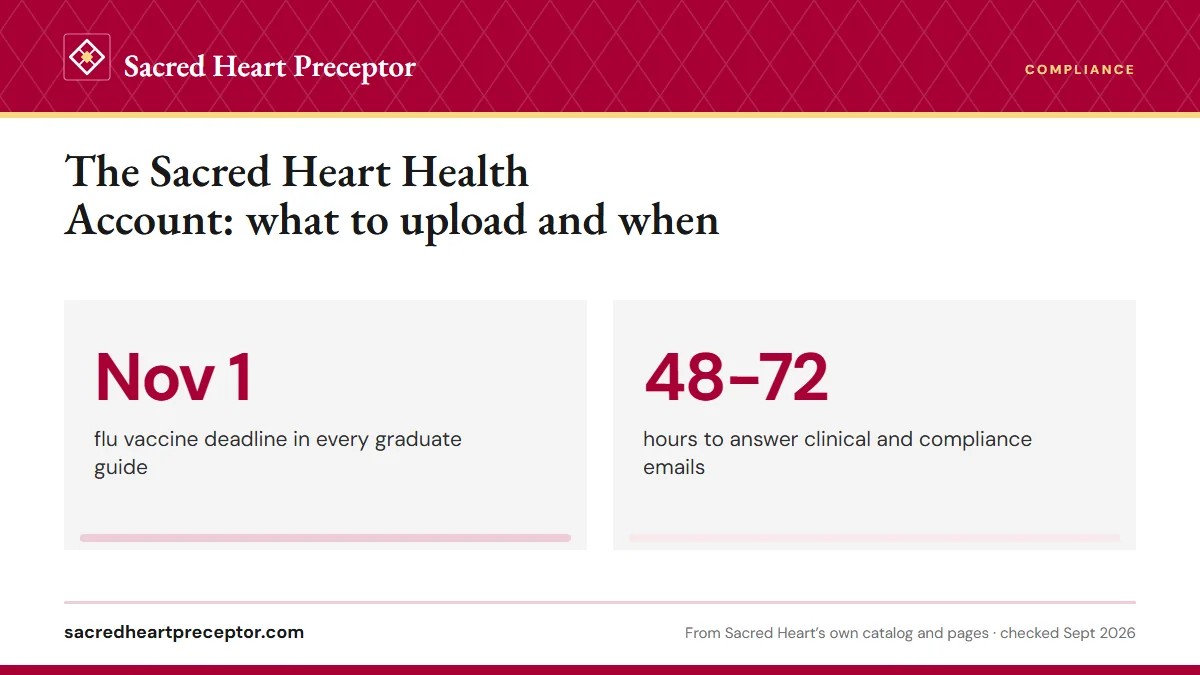
- A seasonal influenza vaccine by November 1, or earlier if your clinical site asks.
Three checks sit beside that list: the yearly criminal background check, a drug screen when the site requires one, and the CHA Health & Safety Test for clinicals in Connecticut. Sacred Heart also requires its Protecting Youth Training Course of all faculty, staff and students, and the FNP/DNP and RN-BSN guides add that students follow outside rules on COVID-19 vaccines, boosters and other immunizations.
CPR and BLS courses Sacred Heart accepts
The guides accept five courses for CPR verification, all at the healthcare-provider level:
- American Heart Association (AHA) BLS for Healthcare Providers
- AHA BLS RQI for Healthcare Providers
- American Red Cross BLS for Healthcare Providers
- ACLS from the AHA or the American Red Cross
- HeartCode BLS from the AHA
If you already hold ACLS through work, it is on the list, so there may be nothing new to buy. A card from a course outside the list is worth checking with the Clinical Placement Team before you rely on it.
Watch the expiry date as well. For MSN NP students, compliance is a standing obligation rather than a one-day check, so a card that lapses between courses takes you out of compliance even after you were cleared.
When compliance is due, program by program
These dates are separate from placement deadlines; for those, see the week-10 deadline page. The wording comes from the 2026-27 guides.
| Program | Fully compliant by |
|---|---|
| Online MSN FNP and MSN PMHNP | Week 10 of NU 552, then for the rest of the program |
| Post-master's FNP certificate | Week 10 of NU 550 |
| Post-master's PMHNP certificate | Week 10 of NU 509 |
| Online MSN CNL, Nursing Education and NMEL | 2 weeks before the clinical course begins |
| RN-BSN and RN-BSN-MSN | No later than 2 weeks before a course with clinical or field work; the Clinical Placement Coordinator sets a firm date |
| Hybrid BSN-to-DNP (FNP) | 30 days before the first day of NU 552, then annually |
| Every graduate guide | Seasonal flu vaccine by November 1, or earlier if the site requires it |
The MSN wording is the strictest: FNP and PMHNP students stay fully compliant "throughout the remainder of the program regardless of when they finish their clinical hours." Finishing your hours early does not end the obligation, and anything with an expiry date needs renewing before it lapses.
What a missed date costs
The MSN guide is blunt about it: a student who misses a published compliance date loses both the clinical or practicum course and the rotation that goes with it. The guide describes no grace period.
Hours are exposed too. Time logged at a rotation you attended while out of compliance, or with a preceptor or site that was never approved, is deleted from your E*Value record; the E*Value page explains the logging rules.
Compliance and placement staff reach you through your SHU email, and the guides expect replies within 48 to 72 hours. A request for one missing document that sits unread for a week can cost more than the document itself.
Clearance is not permanent: an item that expires after you are cleared puts you out of compliance again, and the removal rule applies all over again.
At the site: ID, dress code and allergies
MSN and Post-MSN Certificate students keep their SHU Student ID visible whenever they are at clinical. The dress code calls for a lab coat and a name pin and covers pre-clinical visits too, so wear both the first time you meet a preceptor on site.
If you have a latex allergy, the Latex/Allergy Policy calls for an allergist evaluation and a waiver. Start it early so the paperwork is done by your due date.
Sites can ask for more than Sacred Heart does: a two-step TB test or a blood test, an earlier flu shot, their own screening. Ask for the site's student onboarding list as soon as your preceptor agrees, and add those items to your plan.
How we keep compliance from delaying your start
Your documents go into your own Health Account. Our part is getting the site's requirements to you early: when a preceptor agrees, we ask what the site expects of students beyond Sacred Heart's list, such as the TB test type, flu timing or extra screening, and send it to you with your target dates.
We also pace the search so approval and compliance land together. A complete Health Account with no approved preceptor, or an approved preceptor with a lapsed CPR card, both leave you without the clearance email. The form on this page takes your program and next clinical course; how it works explains the rest.
Questions Sacred Heart students ask
Which company runs the Sacred Heart Health Account?
The guides describe it only as the college's current compliance document tracking service. The College of Nursing Forms page links its Health Requirement Forms to CastleBranch, which is the only compliance vendor named on a public Sacred Heart page. Your program's instructions tell you which account to open and how to connect it.
When is the flu shot due for Sacred Heart clinicals?
Every graduate guide sets November 1 for the seasonal influenza vaccine, or earlier if your assigned clinical site requires it. Sites with their own flu policy can move the date up, so check with the site as soon as your preceptor agrees and upload the record once you have it.
Do I need a Health Account if I do clinicals at my own job?
Yes. All programs require the Health Account, and the FNP/DNP guide says compliance applies even when students complete their clinical hours at their place of employment. Being on the site's payroll does not stand in for the student requirements Sacred Heart checks before it clears you.
Which TB test should I get?
The guide lists a TB test and notes that some sites require a two-step PPD or a blood test. Ask your site which it accepts before you book, because a one-step test that satisfies Sacred Heart can still fall short of the site's rule and cost you a second appointment.
Who pays for Sacred Heart compliance requirements?
You do. Sacred Heart's MSN guide assigns the costs of clinical compliance to students, which takes in the tracking account, exams, tests, the background check and insurance. Prices come from each vendor, so gather them early and order items well before your due date.
Related pages
Last checked 2026-09-25
We check these pages against Sacred Heart's own catalog, program pages and 2026-27 student guides. Your student guide, your academic advisor and your course faculty have the final word.
Sacred Heart asks you to secure your clinical placement. We make that the easy part.
Tell us your Sacred Heart program, your city and your next clinical course. We find preceptors who fit the course and prepare what your advisor, the NP clinical coordinator and the Contract Request Form ask for, early enough for the affiliation agreement.
- Preceptors matched to the course: primary care of adults, women and children for FNP, psychiatric care across the lifespan for PMHNP
- Preceptor CV, license, board certification and the site's contract contact ready before your week-10 deadline
- Close to home in any state where Sacred Heart's program meets licensure requirements, with New York's rule planned around
Start your placement plan
Program, city and clinical start is all we need to begin.