The criminal background check for Sacred Heart clinicals
Sacred Heart runs a criminal background check (CBC) when you apply and again every year until you finish. Students who live or have lived in New York add a statewide search, and a clinical site can ask for more: a recent report, a drug screen, fingerprints or a check of its own.
Get your placement plan
Tell us your Sacred Heart program and where you live. A placement advisor replies with the preceptor and site options that fit your course.
The check at application
The first check happens before you are a student. The MSN guide requires every applicant to an online program of the college to have ordered and received a cleared CBC report during the initial application, and the 2026-27 graduate catalog lists a completed criminal background check among the MSN admission materials.
That report does two jobs. It clears you to enroll, and it becomes something the college can share: a 2021 addendum says the Davis & Henley College of Nursing "has the responsibility to disclose results of the CBC to our clinical agency partners for placement." Assume the site that hosts you may see it.
The ordering steps come with your admission materials and the student guide. The CBC sits beside your Health Account items among Sacred Heart's compliance requirements, and like the rest of them, its cost is yours.
The yearly re-check, and the site's own clock
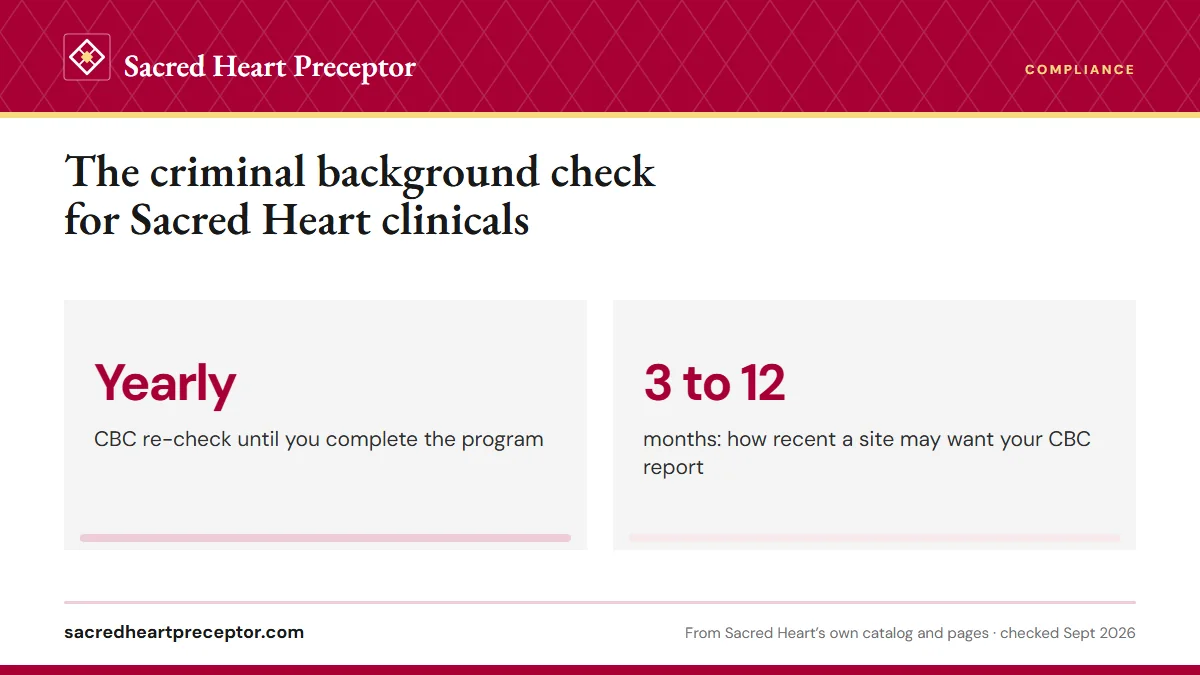
Sacred Heart repeats the check every year: "An annual CBC re-check is required until students complete their program." In a program of two and a half years or longer, that means at least two re-checks after the admission report.
The re-check matters most when a site sets its own recency rule. The guide warns that sites may want a clean CBC dated within three to twelve months. A report that is current for Sacred Heart's yearly cycle can be too old for a site with a three-month rule, so ask the site's window before your start date and order a fresh report if the dates do not line up.
Sacred Heart's yearly cycle and a site's recency window are separate clocks: a CBC that is current for Sacred Heart can be stale for a site that wants one from the last three months.
The added New York search
If you live in New York or have lived there, the guide adds a New York Statewide Criminal History Record Search to your background check, at your cost. Former residents are included, so moving away from New York does not remove the requirement.
Keep this apart from the clinical rule for New York. APRN clinical hours cannot be completed in the state, and New York residents in the NP programs complete their hours in a nearby state, holding an RN license there; the New York clinical rule page covers it. The search follows where you have lived. The clinical rule follows where you train.
Order the New York search together with your first check so your record is complete from the start and nothing waits on a second report.
What a clinical site can add
Sacred Heart's check is the baseline. The guide lists what a site may require on top of it:
- a clean CBC report dated within three to twelve months;
- drug screening;
- colorblindness testing;
- fingerprinting;
- a background check the facility orders and administers itself.
Ask the preceptor or the site's student contact which of these apply, and how far ahead, before you commit to a start date; a facility-run check or a fingerprint appointment may take time to schedule. When the preceptor belongs to a partnering health system, the system signs off before Sacred Heart does, as the approval guide explains, so raise screening questions early in that conversation. The guide puts clinical compliance costs on students, and these extras count among them.
Drug screens: only when the site asks, except in the FNP/DNP
For online MSN and certificate students, the drug screen is conditional. The MSN guide marks it "Only required if your clinical site requires it." When a site does ask, a negative-dilute result has to be retaken at your own expense, so follow the collection instructions closely.
The hybrid FNP/DNP guide reads differently: FNP/DNP students complete a CBC and a drug screen before attending clinical. If you are in the BSN-to-DNP, plan on the screen regardless of the site's own policy.
Either way, the screen belongs on your compliance timeline, not in the week before your first shift. A retake after a dilute result, or a site that sends you to its own lab, can add days you may not have.
If a result comes back positive
A positive CBC does not end a program on its own. The guide says "reasonable efforts will be made to place the student at another site if one can be identified that will accept the positive CBC." If no site will, the student may not be able to progress in the program.
The Graduate Chair meets with students who have a positive CBC or drug screen, and that meeting is where options get worked out. Because the college shares CBC results with its clinical partners, raising a known issue early with your academic advisor gives everyone the most time to find a site that accepts it.
If the outcome is a new site or preceptor, the change goes through a new Contract Request Form and a fresh clearance, as the Cleared for Clinical page explains.
How we plan around screening
When a preceptor agrees to take you, we ask the site for its screening list straight away: how recent the CBC must be, whether it drug-screens, and whether it fingerprints or runs its own check. You get that list with your target dates, so the screens fit inside your compliance window instead of surfacing in the week before you start.
Your results move between you, your screening vendor, Sacred Heart and the site. What we manage is timing and fit: a site whose onboarding matches your calendar, a preceptor whose paperwork is complete, and a second option ready if a site's requirements do not suit you. To start, share your program and upcoming clinical course in the form below; how it works covers our full process.
Questions Sacred Heart students ask
Does Sacred Heart repeat the background check every year?
Yes. After the cleared report you submit with your application, Sacred Heart requires an annual CBC re-check until you complete your program. A site can also ask for a report dated within three to twelve months, which may mean ordering a fresh check sooner than the yearly cycle would.
I lived in New York years ago. Do I need the New York search?
Yes. The guide applies the New York Statewide Criminal History Record Search to students who live or have lived in New York, and the cost is yours. It is separate from the rule that keeps APRN clinical hours out of New York, which depends on where you train, not where you have lived.
Do online MSN students at Sacred Heart take a drug test?
Only if the clinical site requires one, according to the MSN guide. The hybrid FNP/DNP is different: its guide has students complete a drug screen, along with the CBC, before attending clinical. If a site asks and your result comes back negative-dilute, you retake it at your own expense.
Will my clinical site see my background check?
It may. A 2021 College of Nursing addendum says the college has the responsibility to disclose CBC results to its clinical agency partners for placement. Some sites also run a background check of their own, so the site may learn about your history through its own process as well.
Can a positive background check stop my progress?
It can, though not automatically. The guide commits to reasonable efforts to place you at another site that will accept the result, and the Graduate Chair meets with you about options. If no site accepts it, you may not be able to progress, so raise any known issue with your advisor early.
Related pages
Last checked 2026-09-25
We check these pages against Sacred Heart's own catalog, program pages and 2026-27 student guides. Your student guide, your academic advisor and your course faculty have the final word.
- Sacred Heart University, MSN and Post-MSN Certificate Online Programs Student Guide, 2026-2027
- Sacred Heart University College of Nursing, CBC Addendum
- Sacred Heart University, FNP/DNP Hybrid Nursing Program Student Guide, 2026-2027
- Sacred Heart University 2026-2027 Graduate Catalog, Master of Science in Nursing
Sacred Heart asks you to secure your clinical placement. We make that the easy part.
Tell us your Sacred Heart program, your city and your next clinical course. We find preceptors who fit the course and prepare what your advisor, the NP clinical coordinator and the Contract Request Form ask for, early enough for the affiliation agreement.
- Preceptors matched to the course: primary care of adults, women and children for FNP, psychiatric care across the lifespan for PMHNP
- Preceptor CV, license, board certification and the site's contract contact ready before your week-10 deadline
- Close to home in any state where Sacred Heart's program meets licensure requirements, with New York's rule planned around
Start your placement plan
Program, city and clinical start is all we need to begin.