Connecticut APRN law and who can precept you
Connecticut licenses APRNs through its Department of Public Health and requires new APRNs to collaborate with a physician for three years and 2,000 hours before practicing alone. It sets no rule we could find on who may precept an NP student, so Sacred Heart University's program rules decide. Here is the law in plain terms and what it means for your placement.
Get your placement plan
Tell us your Sacred Heart program and where you live. A placement advisor replies with the preceptor and site options that fit your course.
Who oversees APRNs in Connecticut
Three state bodies shape an APRN's career. The Department of Public Health issues the APRN license under § 20-94a. The Board of Examiners for Nursing, twelve governor-appointed members including one APRN (§ 20-88), hears suspension and revocation cases, rules on complaints and approves in-state schools of nursing (§ 20-90). The Department of Consumer Protection's Drug Control Division issues the state controlled substance registration that comes before a DEA registration.
A note on sourcing: the legislature's website could not be reached when this page was researched, so statute wording here comes from an archived copy of the official Chapter 378 page dated September 14, 2026. That page points to the 2026 Supplement for later amendments, which were checked through the Office of Legislative Research summaries.
The collaboration years: three years and 2,000 hours
Section 20-87a(b) holds the core rule. For the first three years after licensure, an APRN must collaborate with a Connecticut-licensed physician whose training relates to the APRN's work. The written agreement covers consultation and referral, coverage, outcome review and disclosure to patients, and sets the APRN's Schedule II and III prescribing level.
| Stage | What the statute requires |
|---|---|
| First three years of licensure | Written collaboration with a Connecticut-licensed physician |
| After three years and 2,000 or more collaborative hours | May practice alone or in collaboration, prescribing in all settings |
| Before practicing without collaboration | Written notice to the Department of Public Health, which lists such APRNs each December 1 |
| Three more years after that | Keep proof of the years and hours for the department |
Public Act 14-12 created the three-year rule effective July 1, 2014, and Public Act 14-231 added the 2,000-hour floor. Since 2023, out-of-state collaboration can count toward the three years for APRNs licensed by endorsement. AANP calls Connecticut full practice, with this period as the qualifier.
What changed in 2025 and 2026, and what stayed
Senate Bill 1064 of 2025, a proposed act on APRN scope of practice, was referred to the Joint Committee on Public Health on January 22, 2025 and went no further, so it never became a public act. The legislature's research office lists no change to the collaboration rule or APRN scope in its summaries of 2025 and 2026 health-profession acts.
The acts that did pass are narrower: a duty to report suspected occupational diseases, and a 2026 requirement that prescribers, APRNs included, weigh non-opioid options for Medicaid patients' pain. For RNs, Connecticut began participating in the Nurse Licensure Compact on October 1, 2025; the separate APRN Compact is not enacted here.
Students under the Nurse Practice Act
Section 20-101 keeps the chapter from blocking students. Nothing in Chapter 378 prohibits students enrolled in schools of nursing approved under § 20-90 from doing work incidental to their course of study, and a separate item covers RNs from other states whose nursing is part of postgraduate courses taken in Connecticut.
How these clauses fit graduate NP students is left open, since § 20-90 approval is written for schools preparing people for examination under the chapter. Sacred Heart's own rule settles the practical side: an active, unencumbered RN license in each state where you do clinical practice. For a Connecticut site that can be a Connecticut license or a multistate license issued by the compact state you live in; the RN license page has more.
No Connecticut rule on who precepts an NP student
Connecticut's nursing education regulations define preceptors only for RN programs: final-year students' preceptors need an RN license, a bachelor's in nursing and two years in the role, with at most two students each. APRN programs go unmentioned, and no statute or regulation on NP student preceptors turned up in our review.
Sacred Heart's program rules are therefore the standard:
- FNP: an MD, DO, PA or APRN licensed in your state of practice, board certified if a physician or APRN, with a year or more of primary care experience.
- PMHNP: the student guide lists MD, DO and APRN licenses; the inquiry form adds some mental health credentials, so confirm with your advisor.
- Every track: no relative or close friend, and the practice or employer supports the arrangement.
Track-by-track detail sits on the preceptor requirements page.
What this means when you choose a Connecticut preceptor
A Connecticut NP still inside the three-year collaboration period is not barred from precepting by any rule we found. Collaboration governs how that NP practices; Sacred Heart's certification and experience rules decide whether they can supervise you.
Collaborative practices can widen your options, since both the NP and the collaborating physician may meet Sacred Heart's FNP rules. If the practice belongs to a partnering health system, that system approves the placement before Sacred Heart's approval.
The common mistake is assuming a title or years in practice settle eligibility. Sacred Heart's rules settle it, and the NP clinical coordinator checks the license and board certification you send.
After graduation: licensure and the 120-day window
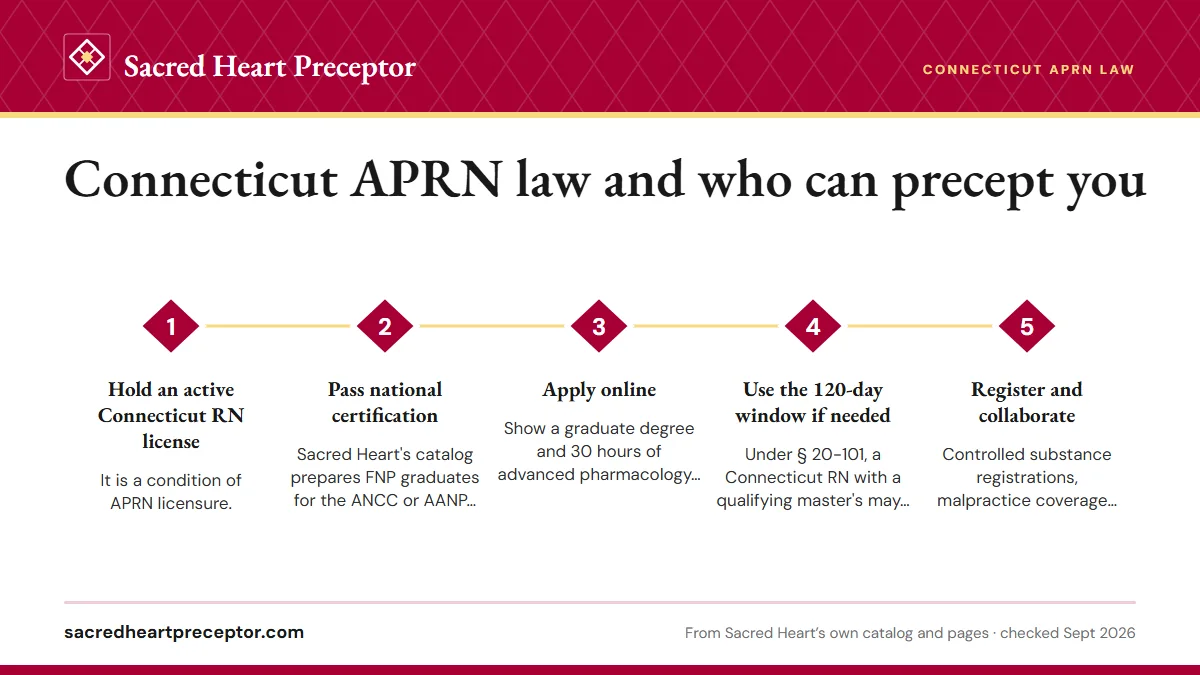
- Hold an active Connecticut RN licenseIt is a condition of APRN licensure.
- Pass national certificationSacred Heart's catalog prepares FNP graduates for the ANCC or AANP exam and PMHNP graduates for the ANCC exam.
- Apply onlineShow a graduate degree and 30 hours of advanced pharmacology, with certification verification and transcripts sent from the source.
- Use the 120-day window if neededUnder § 20-101, a Connecticut RN with a qualifying master's may work as a graduate APRN for up to 120 days after graduation, supervised, without prescribing. Failing the exam ends it.
- Register and collaborateControlled substance registrations, malpractice coverage and a written physician collaboration for the first three years.
Why Sacred Heart students choose us in Connecticut
We check eligibility before anyone commits. For a Connecticut preceptor, your placement advisor confirms the license and board certification, measures the preceptor's experience against your track's rules, checks whether the practice answers to a larger health system that approves students itself, and identifies who signs contracts for the site. You receive a complete packet for your academic advisor and the NP clinical coordinator, so approval turns on the facts rather than on a missing document. If a preceptor later leaves, we find the replacement with the same care. See how we search the state on our Connecticut preceptor guide, or start with the form below.
Questions Sacred Heart students ask
Can an NP in the first three years of practice precept me in Connecticut?
Nothing in Connecticut law that we reviewed prevents it. The collaboration period governs how the NP practices, not whether they may teach. Sacred Heart's rules are the test, which for FNP courses means a licensed, board-certified APRN with at least a year of primary care experience, and your academic advisor and the NP clinical coordinator decide.
Did Connecticut drop the three-year collaboration rule in 2025?
No. Senate Bill 1064, a 2025 proposal on APRN scope of practice, was referred to the Public Health committee in January 2025 and did not become law. The Office of Legislative Research lists no change to the collaboration rule in its summaries of 2025 and 2026 acts, so three years and 2,000 hours still apply.
Does Connecticut limit how many students one preceptor can supervise?
The regulation setting one preceptor for every two students is written for registered nursing programs, and our review found no equivalent for NP students. If your preceptor already hosts students from other schools, mention it to your academic advisor so Sacred Heart can weigh it during approval.
Can I work as an NP in Connecticut right after I graduate?
Possibly, for a limited time. A Connecticut RN with a qualifying master's may practice as a graduate APRN for up to 120 days after graduation, under a physician or APRN and without prescribing, once the employer verifies your exam application. Failing the exam ends the privilege, and the rule is silent on DNP-only graduates.
Related pages
Last checked 2026-09-25
We check these pages against Sacred Heart's own catalog, program pages and 2026-27 student guides. Your student guide, your academic advisor and your course faculty have the final word.
- Connecticut General Statutes, Chapter 378 (archived copy of the official page, September 14, 2026)
- Connecticut Department of Public Health: APRN Practice
- Connecticut Department of Public Health: APRN Graduate Nurse Temporary Practice
- Connecticut Board of Examiners for Nursing
- Sacred Heart University Preceptor Portal: APRN Programs
Sacred Heart asks you to secure your clinical placement. We make that the easy part.
Tell us your Sacred Heart program, your city and your next clinical course. We find preceptors who fit the course and prepare what your advisor, the NP clinical coordinator and the Contract Request Form ask for, early enough for the affiliation agreement.
- Preceptors matched to the course: primary care of adults, women and children for FNP, psychiatric care across the lifespan for PMHNP
- Preceptor CV, license, board certification and the site's contract contact ready before your week-10 deadline
- Close to home in any state where Sacred Heart's program meets licensure requirements, with New York's rule planned around
Start your placement plan
Program, city and clinical start is all we need to begin.