Sacred Heart clinicals in Connecticut, the home state
Sacred Heart University is a Connecticut school, and as of September 2026 Connecticut's row in its licensure disclosures reads "Yes" for both the FNP and the PMHNP. Training here brings its own layer: a three-year collaboration rule for new APRNs, health systems that approve placements before Sacred Heart does, the CHA Health & Safety Test, and a primary care supply thin enough that Connecticut FNP students may train in any state except New York.
Get your placement plan
Tell us your Sacred Heart program and where you live. A placement advisor replies with the preceptor and site options that fit your course.
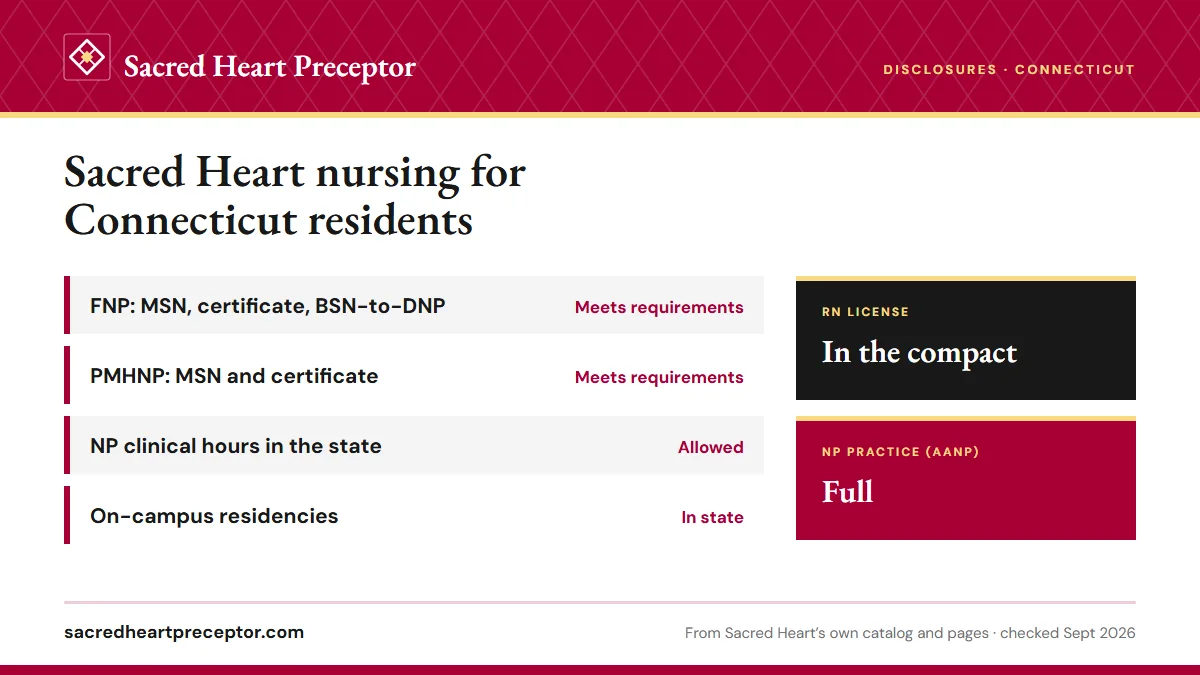
Connecticut's row in Sacred Heart's disclosures
Sacred Heart's State Authorization page names the Connecticut Board of Examiners for Nursing as the regulator for Connecticut and answers "Yes" for both NP licensure programs. The Connecticut Office of Higher Education plays two parts on the same page: it granted the university's SARA participation on January 11, 2017, and it receives non-academic complaints that stay unresolved at Sacred Heart.
| Program | Connecticut disclosure | Delivery | Clinical hours |
|---|---|---|---|
| MSN FNP and post-master's FNP certificate | Yes | Online courses, in-person clinicals | 540 |
| MSN PMHNP and post-master's PMHNP certificate | Yes | Online courses, in-person clinicals | 540 |
| BSN-to-DNP (FNP, hybrid) | Yes | Online plus on-campus intensives | 1,000 minimum (guide) |
| MSN Clinical Nurse Leader | Yes | Online, clinicals on site | 420 (guide) or 400/500 (catalog) |
| MSN NE, MSN NMEL, RN-BSN | Not listed; no new license involved | Online | 180, 120 and 72 |
The catalog makes you responsible for checking state authorization and board approval where you live, so confirm the Connecticut answer with Sacred Heart before you enroll and again before any move. The licensure disclosures guide reads the full table state by state.
Connecticut APRN law in brief
Two bodies share the work. The Department of Public Health issues APRN licenses under § 20-94a, and the Board of Examiners for Nursing, 12 governor-appointed members including one APRN, hears discipline and complaints under §§ 20-88 and 20-90.
The rule that shapes every new NP's early career is § 20-87a(b). For three years after licensure, a Connecticut APRN practices in a written collaboration with a Connecticut-licensed physician; independence opens only after at least three years and 2,000 hours, and only after a written notice to the Department of Public Health. The three-year rule arrived in 2014 through P.A. 14-12, and P.A. 14-231 added the hour floor that same year. AANP still files Connecticut under full practice, noting that transition.
Attempts to loosen it have stalled. SB 1064, a 2025 bill on APRN scope, was referred to the Public Health committee and never became law, and the Office of Legislative Research's summaries of the 2025 and 2026 health-profession acts show the collaboration rule untouched. For students, § 20-101 exempts anyone enrolled in an approved nursing school from the licensing chapter for work incidental to the course. The Connecticut APRN guide explains how these rules shape the preceptor pool.
Who can precept you here
Connecticut's nursing regulations define preceptors only for RN education programs: an RN license, a nursing bachelor's, two years in the specialty and no more than two students per preceptor. We found no Connecticut statute or regulation that sets qualifications for NP-student preceptors, so Sacred Heart's own criteria are the test.
FNP preceptors, per the portal, may be physicians (MD or DO), PAs or APRNs holding a license in the state where they practice; physicians and APRNs must also be board certified, everyone needs at least a year of primary care with adults, women or children, and the practice has to back the arrangement. The MSN guide lists MD, DO and APRN licenses for PMHNP preceptors, and the current PMHNP inquiry form also offers licensed clinical social workers and licensed mental health counselors. No track allows a relative or close friend.
One Connecticut wrinkle: the published criteria say nothing about the three-year collaboration window. They turn on license, certification, experience and employer support, and the call belongs to your academic advisor and then the MSN Online NP Programs Clinical Coordinator. The portal also points Connecticut preceptors to the Connecticut APRN Society and the Connecticut Nurses Association.
Connecticut health systems set their own terms
A Connecticut health system can add a step ahead of Sacred Heart's. The MSN guide says that when a preceptor works for a partnering healthcare organization, the health system signs off before Sacred Heart will approve the preceptor. Published policies differ:
- St. Vincent's Medical Center in Bridgeport, part of Hartford HealthCare, lists Sacred Heart University among its clinical affiliations and links its own fire and safety test.
- Stamford Health lists Sacred Heart among its nursing school affiliations, which span undergraduate and graduate programs.
- Trinity Health Of New England halts a learner at step one without an active affiliation agreement, then wants a learner health form four weeks or more ahead of the first day.
- Hartford HealthCare's Clinician Nexus student system went live in fall 2025 with nursing rotations left out of its current phase.
- Community Health Center, Inc. in Middletown takes training requests from the school, not from the student.
Read each item as that system's own policy; none reserves a seat for any student. The Connecticut NP preceptors guide covers these systems, UConn Health and the state's community health centers in more depth.
Living near campus changes nothing about who finds the site: online students in Connecticut identify their own preceptor like everyone else, and a new site's affiliation agreement can take up to nine months.
Thin primary care, and the any-state-but-New-York option
Sacred Heart says it directly on its State Authorizations page: Connecticut residents face "limited opportunities in primary care." Its remedy is geographic. Connecticut students in the online FNP may look for clinical sites in every state but New York, and the preceptor portal names Connecticut first among the states where it has a particular need for preceptors, ahead of New Jersey, Massachusetts and Rhode Island.
The numbers explain the squeeze. Active APRN licenses in Connecticut rose from 8,533 at the close of 2023 to 9,742 at the close of 2024, though that count mixes NPs with other APRN types and includes license holders living elsewhere. Federal estimates for 2025 put employed NPs at 3,750 statewide:
| Metro area | NPs employed |
|---|---|
| Hartford-West Hartford-East Hartford | 1,370 |
| New Haven | 920 |
| Bridgeport-Stamford-Danbury | 840 |
| Waterbury-Shelton | 290 |
| Norwich-New London-Willimantic | 170 |
| Connecticut total | 3,750 |
HRSA designates 41 primary-care shortage areas in Connecticut, among them Bridgeport's low-income population and two Bridgeport health centers, Southwest Community Health Center and Optimus Health Care. Those designations measure patient need rather than open preceptor slots. When a Connecticut search stalls, the next ring out is New England and New Jersey.
Fairfield, Bridgeport and your campus days
Sacred Heart's Park Avenue campus is in Fairfield, one of six towns in the Greater Bridgeport planning region. The Davis & Henley College of Nursing works out of the Center for Healthcare Education at 4000 Park Avenue in Bridgeport, which houses skills and simulation labs and a primary care clinic with six exam rooms.
Online NP students come to Fairfield for competency residencies, and Sacred Heart's sources count them differently. The online FAQ describes two, each one to two days, during NU 552 and at the end of NU 621; the catalog mentions "a yearly daylong residency each year." Post-master's certificate students plan on one in-person residency a year, and the hybrid FNP/DNP averages about six on-campus classes per semester. Residencies are graded pass/fail, and failing one fails the clinical course, so keep clinical days clear around them. The residencies guide has the rest.
License and compliance for a Connecticut site
Sacred Heart requires an active, unencumbered RN license in the state where your hours happen. Compact membership took effect in Connecticut on October 1, 2025; since then, either a Connecticut license or a multistate license issued by another compact home state satisfies the rule at a Connecticut site. Connecticut residents can now convert to a multistate license, which helps when an FNP search crosses into Rhode Island or New Jersey. Massachusetts has enacted the compact without implementing it, and New York is not a member, so each still calls for its own license. The APRN Compact is not in force here. See the RN license guide.
Any Connecticut placement also calls for the Connecticut Hospital Association's Health & Safety Test, with a score of 85 or higher recorded in your Health Account before the rotation begins; FNP/DNP students complete it before their first course. Timing by program is on the CHA test page.
Why Connecticut students choose us
We know this state's pressure points and plan around them. Your placement advisor searches Connecticut first if that is your wish, from Greater Bridgeport to the Hartford and New Haven areas, and widens to Rhode Island, Massachusetts, New Jersey or farther as soon as primary care looks thin, always outside New York.
Before anything reaches your academic advisor, we confirm the preceptor fits your course and Sacred Heart's criteria, check whether a partnering health system signs off first, and gather the CV, license and board certification, plus the name of the person who signs contracts at the site, which your Contract Request Form asks for. The CHA test and your license go on the checklist, week-10 deadlines stay on the calendar, and if a preceptor drops we start on a replacement right away. Tell us your course and town through the contact form.
Questions Sacred Heart students ask
Does Sacred Heart's FNP qualify me for a Connecticut APRN license?
As of September 2026 Sacred Heart's disclosure answers "Yes" for Connecticut. The Department of Public Health then looks for a Connecticut RN license, national certification, 30 hours of advanced pharmacology and a graduate degree, with your transcript and certification verification sent straight from the source. Sacred Heart's catalog says its 30-hour pharmacology course lets graduates apply. Applications are accepted online only.
Can a Connecticut resident do FNP clinicals in Rhode Island or Massachusetts?
Yes. Sacred Heart lets Connecticut residents in the online FNP train in any state except New York. You need a license valid where you train: Rhode Island recognizes compact multistate licenses, while Massachusetts has not implemented the compact (its board targets May 2027), so a Massachusetts site needs a Massachusetts RN license. Massachusetts also runs its own approval process for out-of-state programs.
Does Sacred Heart use Connecticut's statewide clinical placement system?
The Connecticut Center for Nursing Workforce lists Sacred Heart University among the academic partners of its Student Clinical Placement System, beside practice partners such as Griffin Hospital, Gaylord Hospital and Stamford Health. Its page does not say whether NP placements run through the platform, so treat it as a question for your academic advisor rather than a route to a preceptor.
Will I need a collaborating physician after I graduate?
Yes, if you practice in Connecticut. For your first three years as an APRN, a written collaboration with a Connecticut-licensed physician also sets your Schedule II and III prescribing limits. After three years and 2,000 hours you file a notice with the Department of Public Health before practicing without one. Since 2023, APRNs licensed by endorsement can count collaboration from another state.
Can I work as an NP while waiting for certification results?
In a limited way. Section 20-101 opens a 120-day window after graduation for Connecticut RNs holding a qualifying master's degree: they can work as graduate APRNs in a hospital or similar organization under a physician or APRN, once the employer confirms the exam application. Prescribing is off the table, and the privilege ends if the exam is failed. Whether DNP-only graduates qualify is unclear.
Related pages
Last checked 2026-09-25
We check these pages against Sacred Heart's own catalog, program pages and 2026-27 student guides. Your student guide, your academic advisor and your course faculty have the final word.
Sacred Heart asks you to secure your clinical placement. We make that the easy part.
Tell us your Sacred Heart program, your city and your next clinical course. We find preceptors who fit the course and prepare what your advisor, the NP clinical coordinator and the Contract Request Form ask for, early enough for the affiliation agreement.
- Preceptors matched to the course: primary care of adults, women and children for FNP, psychiatric care across the lifespan for PMHNP
- Preceptor CV, license, board certification and the site's contract contact ready before your week-10 deadline
- Close to home in any state where Sacred Heart's program meets licensure requirements, with New York's rule planned around
Start your placement plan
Program, city and clinical start is all we need to begin.