Sacred Heart University NP clinicals in Wisconsin
Every FNP and PMHNP program at Sacred Heart University carries a "Yes" for Wisconsin on the September 2026 disclosures. Its nursing board also signs off on schools from other states, graduate programs included, and on September 1, 2026 Wisconsin replaced the APNP credential with a four-role APRN license.
Get your placement plan
Tell us your Sacred Heart program and where you live. A placement advisor replies with the preceptor and site options that fit your course.
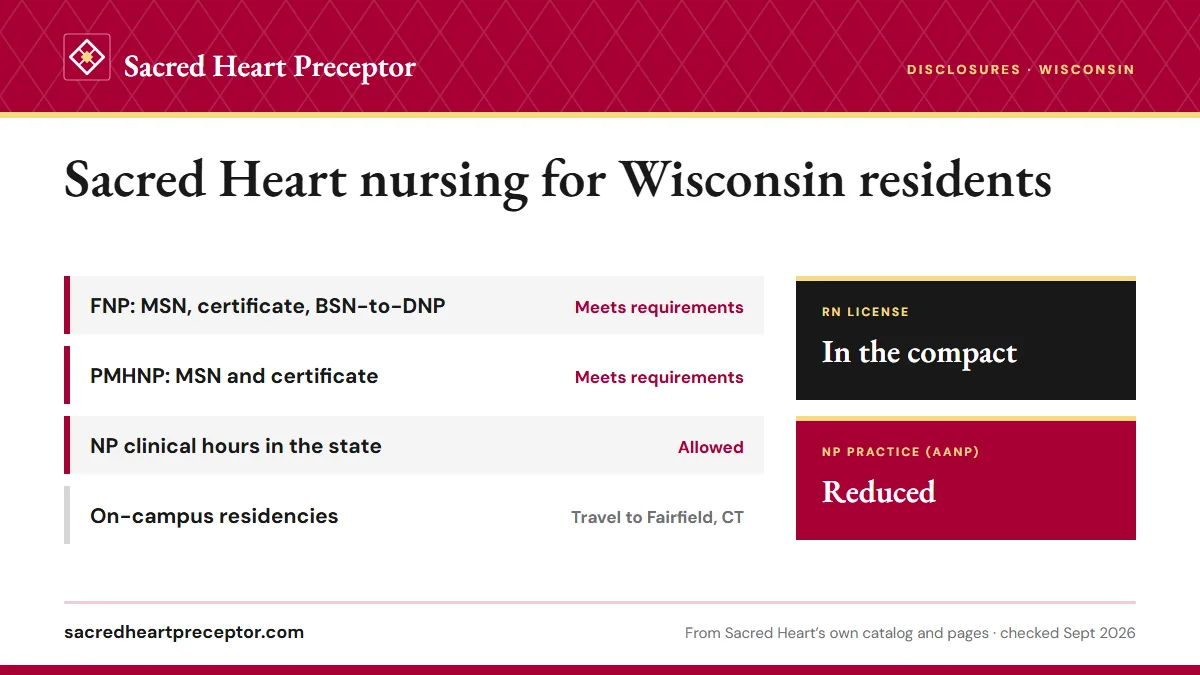
Wisconsin's answers on Sacred Heart's table
| Program | Wisconsin | Delivery | Clinical hours |
|---|---|---|---|
| MSN FNP or FNP certificate | Yes | Online | 540 |
| MSN PMHNP or PMHNP certificate | Yes | Online | 540 |
| BSN-to-DNP FNP | Yes | Hybrid | 1,000 post-baccalaureate (guide) |
| Clinical Nurse Leader | Yes | Online | 420 (guide) or 400/500 (catalog) |
| RN-BSN | Not listed (non-licensure) | Online | 72 |
The RN-BSN row matters here because Wisconsin's form lists bachelor's programs for already-licensed nurses. Verifying your state's status is your job under the catalog, so settle it before enrolling or moving; the disclosures guide explains the columns.
N 1.06: the Board approves schools from other states
The application lives with DSPS, the state's safety and professional services agency, as Form 3067-OEE (revised April 13, 2026). It cites Wisconsin Administrative Code section N 1.06 for the requirements nursing schools based elsewhere must meet, and it places their approval with the Board. The reach is wide: PN programs, associate and bachelor's RN programs, bachelor's programs for nurses already licensed, and graduate programs. Holding on to approval afterward means submitting a self-evaluation report on Form 3069OEE.
Whether Sacred Heart holds Wisconsin approval is not something research could confirm. Raise it with the MSN Online NP Programs Clinical Coordinator or your academic advisor before a Wisconsin preceptor search goes far, and see clinicals outside Connecticut for Sacred Heart's general out-of-state rules.
A Wisconsin plan, in order
- Ask about approvalConfirm with Sacred Heart that your program can place students in Wisconsin under N 1.06.
- Check your own licenseWisconsin's compact membership dates from January 19, 2018, but Minnesota, Illinois and Michigan sit outside the compact. Nurses licensed only there need a Wisconsin license; Iowa's multistate license works.
- Check your preceptor'sAnyone precepting or teaching you at a Wisconsin site must be licensed by Wisconsin or practice there under a privilege to practice.
- Send current credentialsSince the APRN law took effect, DSPS has converted APNP licenses to APRN licenses, so send the preceptor's current license with the CV and board certification.
- File the CRFAdvisor approval and the NP coordinator's approval come first; then the Contract Request Form starts the affiliation agreement (as long as nine months for a new site).
Collaboration, and what Act 17 changed
AANP files Wisconsin under reduced practice because its NPs must collaborate with a physician, and it flags the APRN Modernization Act. 2025 Wisconsin Act 17 gave DSPS four APRN roles to license: the clinical nurse specialist and the nurse-midwife, along with the nurse anesthetist and the nurse practitioner. An APRN aiming for independent practice, apart from a physician, files a separate application and must win the Board's approval, so your preceptor's practice model may shift during your program.
Act 17 leaves Sacred Heart's standards where they were. An FNP preceptor still needs a year in primary care and, unless a PA, board certification; a PMHNP preceptor is a psychiatric NP or a psychiatry-certified physician. See preceptor requirements.
Milwaukee, Madison, Green Bay, Appleton
Milwaukee-Waukesha leads with about 1.58 million people in 2025 Census estimates, and Madison follows near 710,000. In the northeast, Appleton counts about 250,000 and Green Bay about 337,000. Students there weigh Froedtert ThedaCare Health and Aurora Health Care, which belongs to Advocate Health, as well as Ascension Wisconsin, Aspirus Health and UW Health. These are places to search, not confirmed Sacred Heart sites. Research found no Wisconsin preceptor incentive.
Why Wisconsin students choose us
Wisconsin adds checks to every placement, and we build them into the search: approval questions raised early, each preceptor's Wisconsin license or privilege confirmed, APRN-era credentials collected, and the site's contract contact ready for your CRF. Your placement advisor starts from your address; use the contact form.
Questions Sacred Heart students ask
Does Wisconsin approve out-of-state graduate nursing programs?
Yes. DSPS Form 3067-OEE ties approval of nursing schools based outside Wisconsin to N 1.06 and the Board, and it lists graduate programs alongside associate and bachelor's ones. Ask Sacred Heart how its NP programs stand before you commit to a Wisconsin site.
I live in Minnesota near the border. Can I train in Wisconsin?
Minnesota is not a compact state, so a Minnesota license does not reach Wisconsin sites. You would need a Wisconsin RN license, since Sacred Heart requires one valid in the state where you train. Sacred Heart's disclosures also mark Minnesota "Yes", so training at home remains open.
My preceptor's license changed from APNP to APRN. Does that matter?
It helps to send the new one. Wisconsin converted existing APNP licenses to APRN licenses on the Act's September 1, 2026 start date, and Sacred Heart's NP coordinator reviews a current license with the preceptor's CV and board certification. The conversion does not change who may precept you under Sacred Heart's rules.
Does N 1.06 cover Sacred Heart's RN-BSN too?
The DSPS form covers bachelor's completion programs for licensed RNs. RN-BSN students in Wisconsin should raise it with the academic advisor at the start, since Sacred Heart's RN-BSN clock starts nine months before your first clinical course, and the approval question should be settled before you name a site.
Related pages
Last checked 2026-09-25
We check these pages against Sacred Heart's own catalog, program pages and 2026-27 student guides. Your student guide, your academic advisor and your course faculty have the final word.
Sacred Heart asks you to secure your clinical placement. We make that the easy part.
Tell us your Sacred Heart program, your city and your next clinical course. We find preceptors who fit the course and prepare what your advisor, the NP clinical coordinator and the Contract Request Form ask for, early enough for the affiliation agreement.
- Preceptors matched to the course: primary care of adults, women and children for FNP, psychiatric care across the lifespan for PMHNP
- Preceptor CV, license, board certification and the site's contract contact ready before your week-10 deadline
- Close to home in any state where Sacred Heart's program meets licensure requirements, with New York's rule planned around
Start your placement plan
Program, city and clinical start is all we need to begin.