Training in North Carolina as a Sacred Heart University NP student
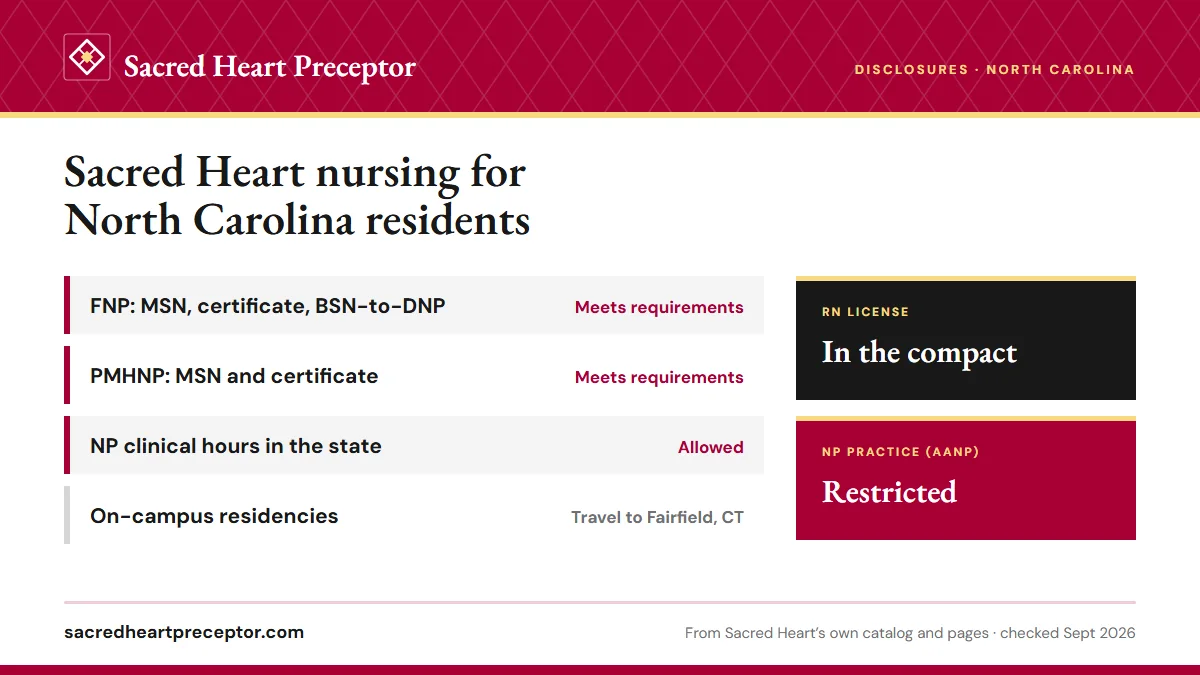
North Carolina residents can take Sacred Heart University's online FNP or PMHNP: as of September 2026, both licensure disclosures list the state as "Yes". Because the North Carolina Board of Nursing keeps post-licensure graduate study outside its approval process, most of your effort goes into one thing: a preceptor who suits the Sacred Heart course, working at a site prepared to sign an affiliation agreement.
Get your placement plan
Tell us your Sacred Heart program and where you live. A placement advisor replies with the preceptor and site options that fit your course.
North Carolina on Sacred Heart's table
Sacred Heart's State Authorization page answers the licensure question track by track, and each NP option carries a "Yes" beside North Carolina (September 2026). Sacred Heart has belonged to NC-SARA since January 11, 2017. The catalog leaves the last check with you, so reread that page before you enroll or relocate.
| Track | North Carolina | Format | Clinical hours |
|---|---|---|---|
| Online MSN FNP | Yes | Online courses, in-person clinicals | 540 (NU 561, NU 606, NU 607, NU 621) |
| Online MSN PMHNP | Yes | Online courses, in-person clinicals | 540 (NU 571, NU 572, NU 573) |
| Post-master's FNP or PMHNP certificate | Yes | Online | 540 |
| Online MSN CNL | Yes | Online | 420 in the guide; 400 or 500 in the catalog |
Every other state appears in the licensure disclosures guide.
What the NCBON regulates, and what it leaves alone
Rule 21 NCAC 36 .0233 governs out-of-state programs whose students are not yet licensed. Under it, a North Carolina agency's chief nurse administrator petitions the Board 30 or more days before the rotation, attaching home-state approval and faculty credentials. Licensed RNs in graduate study, which is what you will be, fall outside that petition.
According to the NCBON's education FAQ, the Board takes no position, approving or disapproving, on post-licensure graduate programs from anywhere. One line in that FAQ does reach you: master's and doctoral students who hold no North Carolina license and no multistate license are told to write to the Licensure Department, via the Board's Email Us form, before training in the state.
A career-long physician agreement
On AANP's map North Carolina is restricted. Every NP there practices under a physician agreement that lasts the length of the career, and NP licensure answers to a Joint Subcommittee drawn from the nursing and medical boards. That structure often puts two possible FNP preceptors in one practice, because Sacred Heart accepts MDs, DOs, PAs and APRNs licensed where they practice, with board certification for physicians and APRNs and a year of primary care behind them. PMHNP students use a separate list; see who can precept you.
No state-funded preceptor credit or stipend for North Carolina turns up in our research.
Charlotte, the Triangle and the Triad
Population clusters around four metros. Charlotte-Concord-Gastonia counts roughly 2,485,000 North Carolina residents in the 2025 Census estimates; Raleigh-Cary is next near 1,596,000, then Greensboro-High Point (about 806,000) and Winston-Salem (about 712,000). Students there tend to approach ECU Health, Duke Health, Novant Health, UNC Health, or Atrium Health, which now sits inside Advocate Health and is based in Charlotte.
Treat each as a door to knock on, not a Sacred Heart site. When the preceptor is on a partnering health system's payroll, the system's own sign-off comes first, then Sacred Heart's coordinator. A small independent practice outside the four metros is every bit as usable, as long as it will enter an affiliation agreement.
Charlotte's metro spills over into South Carolina. Choose a clinic on that side and South Carolina's rules follow you, so check the South Carolina guide first.
One compact license, two Carolinas
Compact membership dates to January 19, 2018 in North Carolina. Hold the state's multistate RN license and Sacred Heart's rule (a current, unrestricted RN license valid wherever you log hours) is met here and across other compact states, South Carolina among them. The APRN Compact is a different agreement, and North Carolina has not adopted it. The RN license for clinicals page covers the rest.
Why North Carolina students choose us
We go looking in your county for a preceptor whose patient panel suits your Sacred Heart course, whether that is adult primary care for NU 561 or the under-18 hours NU 572 demands. By the time your academic advisor reviews the proposal, the preceptor's CV, license and board certification are already collected, along with the contracts contact the Contract Request Form needs, so the affiliation agreement for a new site (it can run nine months) gets moving early. We keep an eye on your week-10 date and remain on call should a preceptor leave. Start at the contact page.
Questions Sacred Heart students ask
Must the NCBON approve Sacred Heart's nurse practitioner program?
Nothing in the Board's guidance calls for it. The NCBON's education FAQ says it takes no approve-or-disapprove role for post-licensure graduate programs, and 21 NCAC 36 .0233 addresses students who are not yet licensed. What you bring is an RN license North Carolina recognizes.
My license comes from a non-compact state. Can I train in North Carolina?
Write to the NCBON Licensure Department first, using the Board's Email Us form; graduate students holding no North Carolina or multistate license are asked to do that before clinical experiences there. Sacred Heart separately insists on an unencumbered RN license valid where you train, so sort the license out before proposing a site.
Do my North Carolina hours still count if I move mid-program?
Hours logged at an approved, cleared site stay with the course they were earned in. The move shapes your next placement instead: Sacred Heart cautions that ignoring a new state's requirements can block placements there, and every new site goes through approval, a fresh Contract Request Form and clearance.
Is Duke Health or UNC Health a Sacred Heart clinical site?
Neither appears in our research as one. Both are large systems where North Carolina NP students inquire, each with its own student process, and a preceptor on either payroll needs the system's approval ahead of Sacred Heart's final approval.
Related pages
Last checked 2026-09-25
We check these pages against Sacred Heart's own catalog, program pages and 2026-27 student guides. Your student guide, your academic advisor and your course faculty have the final word.
Sacred Heart asks you to secure your clinical placement. We make that the easy part.
Tell us your Sacred Heart program, your city and your next clinical course. We find preceptors who fit the course and prepare what your advisor, the NP clinical coordinator and the Contract Request Form ask for, early enough for the affiliation agreement.
- Preceptors matched to the course: primary care of adults, women and children for FNP, psychiatric care across the lifespan for PMHNP
- Preceptor CV, license, board certification and the site's contract contact ready before your week-10 deadline
- Close to home in any state where Sacred Heart's program meets licensure requirements, with New York's rule planned around
Start your placement plan
Program, city and clinical start is all we need to begin.