Doing Sacred Heart clinicals where you already work
Plenty of Sacred Heart University students train at their own employer, and Sacred Heart's online FAQ says as much. The rules shift by program: RN-BSN students may use their employer's institution but not their own unit, DNP students must keep job duties and practice hours clearly apart, and NP students answer the Contract Request Form's employment questions and follow their advisor's direction.
Need a site beyond your employer?
We look inside your own system when it fits, then widen to practices near you that match your course.
What Sacred Heart says about employers
The online FAQ is encouraging: clinical hours for most specializations happen at a healthcare facility of your choosing, and "many students arrange this at their current employer." For working nurses, that is a natural starting point, since you already know the people, the systems and often the person who signs student agreements.
The formal rules are narrower, and they vary. The student guides set a clear limit for RN-BSN students and a separation rule for DNP students. For NP students, the guides contain no written rule on training at your own workplace or under your supervisor, so your academic advisor decides case by case. That makes an honest, early conversation with the advisor the most useful step for any NP student eyeing an employer site.
The employment questions on the form
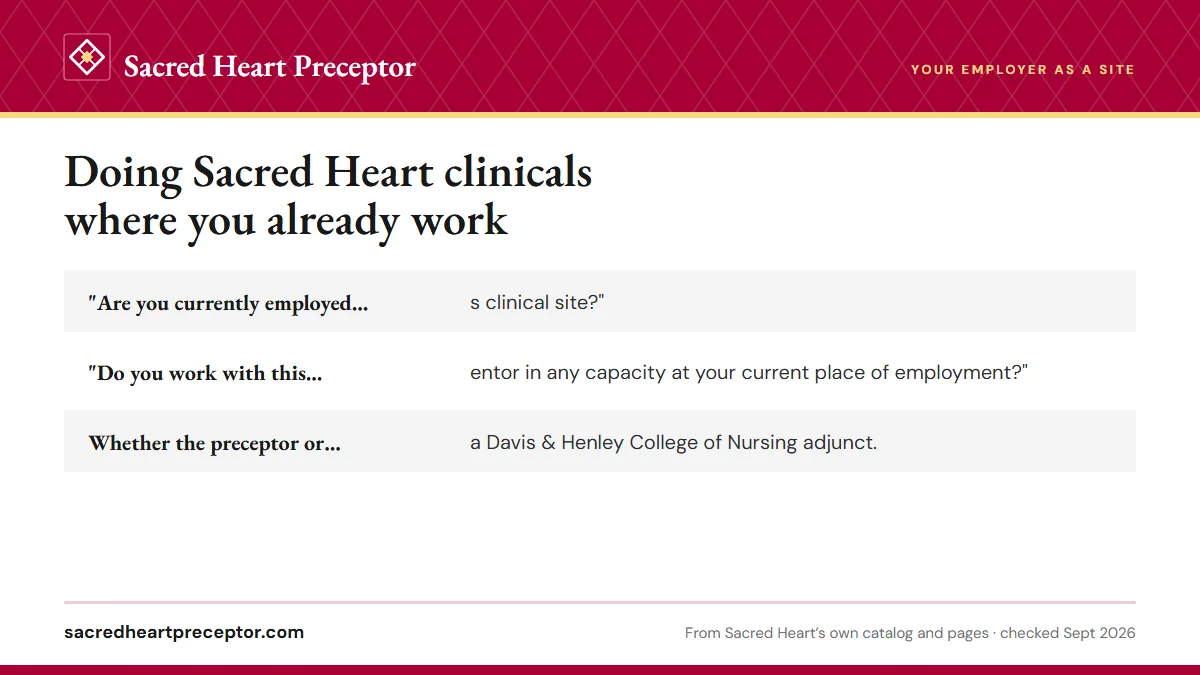
A placement at your job is always disclosed. The Contract Request Form asks:
- "Are you currently employed at this clinical site?"
- "Do you work with this preceptor/mentor in any capacity at your current place of employment?"
- Whether the preceptor or mentor is a Davis & Henley College of Nursing adjunct.
The NP versions also ask in what capacity you work with the preceptor. Answer precisely. A clinician who works in the same building but never with you is a different case from your direct supervisor, and the reviewers can only weigh what you tell them. Keep the answers consistent with what you tell your advisor, since both describe the same working relationship. Vague answers tend to invite follow-up questions and delay.
RN-BSN and RN-BSN-MSN: your institution, not your unit
The RN-BSN guide draws the line plainly: students may do fieldwork or clinical within the institution that employs them, but not on the unit or clinic where they currently work. A medical-surgical nurse at a large hospital might, for example, complete care management hours with a case management team or a population health project on a different service. In practice, the rule sends you to a new corner of your organization, where you learn a different area of care from people who do not supervise your paid work.
Everything else follows the usual RN-BSN route. The preceptor's CV and RN license go to your academic advisor, and the search starts nine months before your first clinical practice course, in NU 376 or NU 387. The RN-to-BSN page covers the program's courses and hours.
NP students: making an employer site work
For FNP and PMHNP students, an employer can be a strong site when the clinical role fits the course and the preceptor fits the track. An inpatient nurse usually cannot collect primary care hours on an inpatient unit, but the same health system may run outpatient primary care, pediatric or women's health practices, or behavioral health clinics where you have never worked.
Three questions settle most cases. Does the setting match the course population? How does the preceptor relate to you at work, and could your advisor see that as a conflict? And can you keep your student role distinct from your paid role while you are there? Take those answers to your advisor before you propose the site, and check the preceptor against who can precept.
Assuming your own manager can precept you is the common misstep. The form asks how you work with the preceptor, so clear the arrangement with your advisor before you commit.
DNP students: employment and practice hours stay separate
Both DNP guides require "a clear distinction between current employment and practice hours" and the project. Regular job duties do not turn into practice hours because they happen at the project site. Structure the project so its hours, goals and mentor oversight stand apart from your paid role. When you write the proposal, spell out which hours belong to the project and which belong to your job, so your mentor and DNP advisor can confirm the split.
The practice mentor must hold a position that can open access within the organization, which often points toward an employer you already know. Log project hours in E*Value, and expect DNP project clearance only after the site's form, the practice site paperwork and IRB approval are complete. The post-master's DNP page covers the program's hours and mentor in full.
Compliance still applies at work
Working somewhere waives nothing. The FNP/DNP guide spells it out: compliance is required even when clinical hours happen at the place of employment. You still need an affiliation agreement between Sacred Heart and your employer, a complete Health Account and the Cleared for Clinical email before your first student shift. MSN and certificate students must also display their SHU Student ID in the clinical setting; at your own employer, that badge signals to colleagues when you are there as a student.
If your employer has never hosted Sacred Heart students, the contract may take months; the affiliation agreements page explains why. Ask your education or human resources department early whether a student agreement process already exists, and who the contract contact would be.
When your employer is not the answer
Some employers lack the right population, and some managers cannot spare a preceptor. Your placement advisor looks inside your own system first when it fits, then widens to nearby practices that match your Sacred Heart course, screening each preceptor for the workplace relationships the form asks about. For NP students we favor outpatient practices that match the course population, and for RN-BSN students, services away from your own unit. Every match is checked against Sacred Heart's rules before it reaches you. Your employer stays one option, never the only one.
You receive a match with the contract contact ready, so the agreement can start early and your advisor sees a clean proposal. Tell us where you work and what your course needs in the form below.
Questions Sacred Heart students ask
Can my nurse manager be my preceptor?
The guides set no written rule on this for NP students, but the Contract Request Form asks whether and how you work with the preceptor, and Sacred Heart bars preceptors with an evident conflict of interest. RN-BSN students may not train on their own unit at all. Ask your academic advisor before you propose a supervisor.
Can my paid shifts count as clinical hours?
Sacred Heart's DNP guides require a clear distinction between employment and practice hours. For NP, CNL, NE, NMEL and RN-BSN courses, the public guides do not settle whether paid shifts can double as clinical time. Ask your academic advisor, and plan on separate, dedicated clinical time unless you are told otherwise.
Can a New York resident train at a New York employer?
Not for NP clinical hours. Sacred Heart is restricted from offering APRN-licensure clinical placements in New York, so NP students train in a neighboring state with that state's RN license. Students in non-licensure programs (RN-BSN, the non-NP MSN tracks and the post-master's DNP) may complete preceptorships in New York agencies. See the New York rule.
Does using my employer make approval faster?
It can. You already know who handles student placements, the site may have hosted Sacred Heart students before, and an existing agreement removes the longest wait. It still goes through the same advisor and NP coordinator review, the same Contract Request Form and the same clearance email as any other site.
What if my employer does not take students?
Many large employers limit student placements or route them through a central office. If yours declines, look at practices outside your system in your own community that fit the course. Our placement advisors run that search for Sacred Heart students and hand you the preceptor packet and contract contact ready for your advisor.
Related pages
Last checked 2026-09-25
We check these pages against Sacred Heart's own catalog, program pages and 2026-27 student guides. Your student guide, your academic advisor and your course faculty have the final word.
- Sacred Heart University RN-BSN and RN-BSN-MSN Student Guide, 2026-2027
- Sacred Heart University MSN/FNP Online Contract Request Form (CRF)
- Sacred Heart University PM-DNP Hybrid Nursing Program Student Guide, 2026-2027
- Sacred Heart University FNP/DNP Hybrid Nursing Program Student Guide, 2026-2027
- Sacred Heart University Online: FAQ
Sacred Heart asks you to secure your clinical placement. We make that the easy part.
Tell us your Sacred Heart program, your city and your next clinical course. We find preceptors who fit the course and prepare what your advisor, the NP clinical coordinator and the Contract Request Form ask for, early enough for the affiliation agreement.
- Preceptors matched to the course: primary care of adults, women and children for FNP, psychiatric care across the lifespan for PMHNP
- Preceptor CV, license, board certification and the site's contract contact ready before your week-10 deadline
- Close to home in any state where Sacred Heart's program meets licensure requirements, with New York's rule planned around
Start your placement plan
Program, city and clinical start is all we need to begin.