Sacred Heart University FNP clinical hours: 540 in four courses
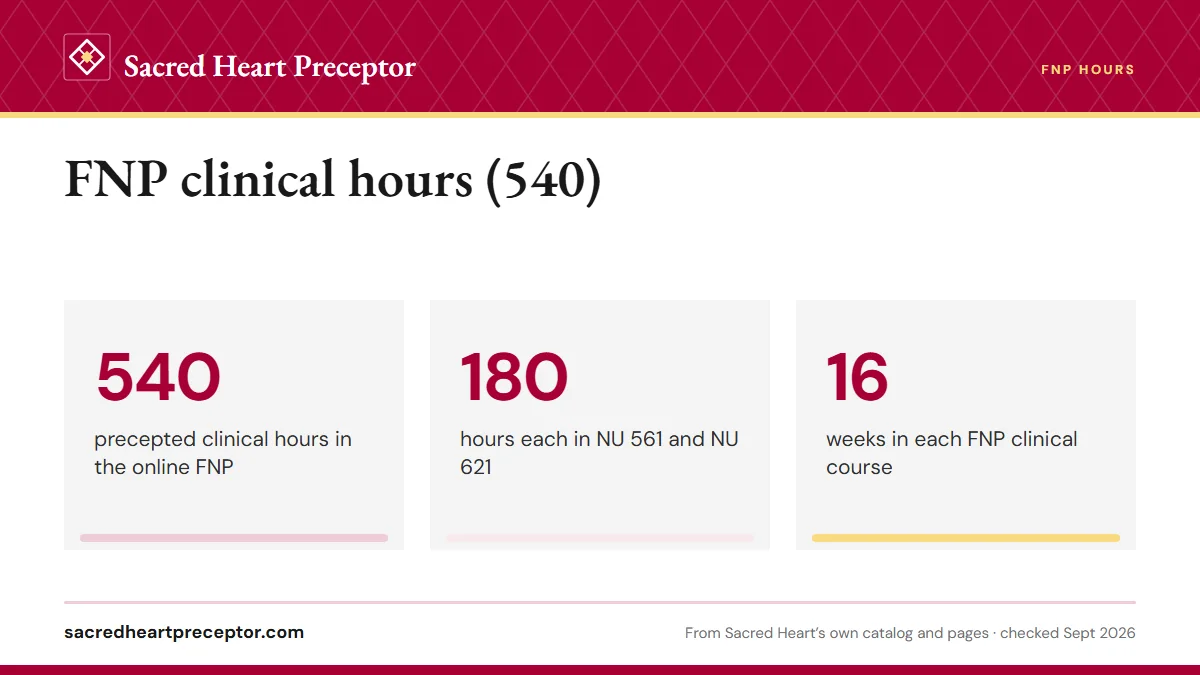
Sacred Heart University's online MSN FNP and post-master's FNP certificate both require 540 precepted clinical hours, split 180, 90, 90 and 180 across NU 561, NU 606, NU 607 and NU 621. Residency lab hours come on top: 15 in the student guide, 10 in the catalog. Each block trains you with a different population, so each one needs a preceptor chosen for that course.
Get your placement plan
Tell us your Sacred Heart program and where you live. A placement advisor replies with the preceptor and site options that fit your course.
The 540 hours, block by block
The catalog course pages for NU 561 and NU 621 list no hours, so their 180-hour figures come from the 2026-27 MSN student guide. The catalog does print the 90 for each of NU 606 and NU 607, and it gives the program total as a minimum of 540 clinical hours.
| Course | Title | Credits | Clinical hours | Key prerequisites |
|---|---|---|---|---|
NU 561 | Primary Care I: Comprehensive Primary Care of the Adult | 6 | 180 | NU 551, NU 552, NU 566 |
NU 606 | Primary Care of Children | 4 (3 didactic, 1 clinical) | 90 | NU 561 plus the core and specialty foundations |
NU 607 | Primary Care for Women | 4 | 90 | Same list as NU 606 |
NU 621 | Primary Care II: Advanced Primary Care of Families in Complex Systems | 7 | 180 | NU 561, NU 606, NU 607 and earlier courses |
| Residency lab | On-campus competency lab hours | None | 15 (guide) or 10 in residency 1 (catalog) | Held in Fairfield |
Post-master's FNP certificate students take the same four courses for the same 540 hours. To compare the FNP with other Sacred Heart programs, see the clinical hours overview.
NU 561: 180 hours with adults
NU 561 is the first of the four clinical courses and, with NU 621, the largest single block. The catalog centers it on the well adult: illness prevention, health maintenance, and the diagnosis and treatment of common primary care problems, with emphasis on the consultation role of the nurse practitioner.
The preceptor profile follows from that description. A primary care practice with a steady adult panel, where you can take histories, examine patients and help shape plans, fits the course far better than a narrow specialty clinic. Sacred Heart's course-description page lists NU 561 for the spring and summer semesters.
Its placement is due by the end of week 10 of NU 552, the course before it, and the NU 561 page covers the site profile in detail.
NU 606 and NU 607: 90 hours each
The middle two courses are half the size and twice as specific. NU 606 Primary Care of Children runs from birth through adolescence across diverse infant, child and adolescent populations, taught through a collaborative community approach with interprofessional teams. You need a site where children make up a real share of the schedule, such as a pediatric office or a family practice with a busy pediatric panel.
NU 607 Primary Care for Women covers well woman care and care of the antepartum woman, from adolescence through the menopause transition, including cervical and breast cancer screening, contraceptive care, gynecologic conditions and healthy prenatal examinations. A women's health or family practice that sees prenatal visits matches that list.
Both courses share one prerequisite list, which includes NU 561. The FNP Contract Request Form records each site's primary and secondary population (Primary/Preventive Care, Women's Health, Pediatrics, Specialty Care), so the mix is on file for NU 606 and NU 607 alike.
NU 621: 180 hours and the finish
NU 621 is the fourth and final clinical course, with 7 credits and the program capstone built in. The catalog describes common and complex primary care problems in complex adult families and their members, with weight on the leadership side of the NP role, so a preceptor who manages chronic, multi-problem patients gives you the caseload the course expects.
The SHU Online FAQ places the second on-campus residency at the end of the program in NU 621. Residency is graded pass or fail, and an unsuccessful residency carries a clinical course down with it under the MSN guide, so fit your clinic days around the residency once course faculty set the dates. The NU 621 page has more on the course.
Residency lab hours: 15 or 10
Lab hours sit outside the 540. The MSN guide asks for a minimum of 540 clinical hours and 15 lab hours, while the catalog lists 540 clinical hours and 10 lab hours completed during residency 1. Neither source folds lab time into the preceptor count.
Residency timing carries its own conflict. The SHU Online FAQ sets two one-to-two-day competency residencies in Fairfield, one during NU 552 and one in NU 621, after a virtual orientation early in the first term. The catalog mentions two onsite competency residencies and, elsewhere, a daylong residency each year. Dates are not published, so take them from course faculty and the student guide.
Pacing 540 hours inside 16-week courses
Each FNP clinical course runs 16 weeks (15 to 16 by the online curriculum page's count). At 180 hours that works out to roughly 11 and a quarter hours a week if you log from week one; at 90 hours, a little under 6. Every week lost to a late clearance raises the weekly load, because hours worked before the Cleared for Clinical email are deleted.
The 2026-27 registrar calendar puts MSN/FNP terms at August 31 to December 12, January 4 to April 23, and April 26 to August 6. A student who runs short can stay enrolled through NU 600 Continuous Enrollment while finishing hours. The SHU Online FAQ speaks of the hours spread over three semesters while the guide and catalog use four courses, so your plan of study is the place to see which term holds each one.
The next placement comes due while you are still logging the current one: by week 10 of each clinical course, per the MSN guide. The week-10 deadline page explains the cycle.
Start the next search while this course's hours are still running. Waiting until a course ends to look for the next preceptor misses the week-10 checkpoint, and contracting a brand-new site can take as long as nine months.
How we build your four-placement plan
Four preceptors, four population profiles and four approval windows, all inside 16-week courses: that is why Sacred Heart FNP students come to us. We map the whole sequence at once, adult primary care in NU 561, children's care in NU 606, women's health in NU 607 and complex families in NU 621, so the next placement is already moving when week 10 arrives.
Every preceptor we bring matches Sacred Heart's published profile: a physician (MD or DO), PA or APRN holding a license in your state, board certified if a physician or APRN, with a year or more in primary care. We collect the CV, license and board certification plus the contracts contact at the site for your Contract Request Form, keep every site outside New York, and get a replacement search moving the moment a preceptor steps away. Sacred Heart approves each placement, and we hand it a complete file every time. Tell us your start term in the form below.
Questions Sacred Heart students ask
Can one family practice cover all four Sacred Heart FNP courses?
Sacred Heart's published sources do not settle this either way. Each course is approved on its own, by week 10 of the course before it, and each has a different population focus, so a single site would need real adult, pediatric, women's health and complex-family volume. Ask your academic advisor before building a plan around one practice.
Why does one Sacred Heart page say the FNP hours take three semesters?
The SHU Online FAQ describes 540 clinical hours spread over three semesters. The MSN student guide and the catalog assign the hours to four clinical courses at 180, 90, 90 and 180. The course list is the one to plan by, and the plan of study from your academic advisor shows which term each course falls in.
Can Sacred Heart FNP clinical hours be done through telehealth?
Only now and then. The catalog describes MSN FNP hours as in person, with occasional telehealth hours when the preceptor directs them. Plan for in-person clinic days across all four courses, treat any telehealth time as the exception your preceptor decides on, and log it in E*Value like any other hour.
Can I complete Sacred Heart FNP hours in New York?
No. New York rules bar Sacred Heart University from placing APRN students in clinical rotations there, so every FNP clinical hour happens in another state. New York residents may train in a neighboring state if they hold a valid RN license there. The New York rule page covers the details.
Does the post-master's FNP certificate need all 540 hours?
Yes. On the certificate's catalog page, the 540 preceptor hours are tied to the same four courses, NU 561, NU 606, NU 607 and NU 621, each 16 weeks long. Certificate students need full compliance by week 10 of NU 550, the course before their first clinical course, and the SHU Online FAQ mentions one in-person residency per year.
Related pages
Last checked 2026-09-25
We check these pages against Sacred Heart's own catalog, program pages and 2026-27 student guides. Your student guide, your academic advisor and your course faculty have the final word.
- Sacred Heart University MSN and Post-MSN Certificate Online Student Guide, 2026-2027
- Sacred Heart University 2026-2027 Graduate Catalog: Master of Science in Nursing
- Sacred Heart University 2026-2027 Graduate Catalog: Post-Master's Certificate, FNP Online
- Sacred Heart University Preceptor Portal: APRN Programs
- SHU Online: Frequently asked questions
Sacred Heart asks you to secure your clinical placement. We make that the easy part.
Tell us your Sacred Heart program, your city and your next clinical course. We find preceptors who fit the course and prepare what your advisor, the NP clinical coordinator and the Contract Request Form ask for, early enough for the affiliation agreement.
- Preceptors matched to the course: primary care of adults, women and children for FNP, psychiatric care across the lifespan for PMHNP
- Preceptor CV, license, board certification and the site's contract contact ready before your week-10 deadline
- Close to home in any state where Sacred Heart's program meets licensure requirements, with New York's rule planned around
Start your placement plan
Program, city and clinical start is all we need to begin.