NU 572: 180 PMHNP hours, at least 100 of them with patients under 18
NU 572 is Sacred Heart University's child and family PMHNP practicum: 6 credits and 180 clinical hours, with a catalog requirement that at least 100 of those hours go to patients under age 18. That single rule shapes the placement more than anything else, because the site has to see enough young patients for you to reach 100 within one course.
Searching for a child and adolescent site?
Tell us your state and when NU 572 starts.
The 100-hour rule, broken down
The catalog wording is precise: at least 100 hours of the clinical practicum are "specifically devoted to the care of patients under age 18". The remaining hours still sit inside a course whose stated emphasis is pediatric and adolescent patients.
| Block | Hours | What Sacred Heart says |
|---|---|---|
| Patients under 18 | At least 100 | A required minimum in the catalog course description |
| Remaining hours | Up to 80 | Course emphasis stays on pediatric and adolescent patients within behavioral health settings |
| Course total | 180 | 6 credits; the same total in the catalog and on the SHU Online program page |
Keep your clinical logs detailed enough that the under-18 total can be verified at a glance, and ask course faculty early how they want age recorded. The PMHNP clinical hours page places this rule within the 540-hour program.
Catalog title versus program-page title
In the 2026-27 catalog, NU 572 is PMHNP II: Care of Children and Families. The SHU Online PMHNP page names it PMHNP II: The Psychiatric Nurse Practitioner's Role with Children and their Families. Both describe the same 6-credit, 180-hour course, and both put children and families at the center, so either title points you toward the same kind of site.
Prerequisites are the NU 571 list (NU 501, NU 530, NU 550, NU 566, NU 552, NU 551, NU 603 and NU 509) plus NU 571 itself. Post-master's certificate students may enter through certificate admission with approval. Courses in the certificate run 16 weeks, per its catalog page. When you describe the course to a prospective preceptor, either title works; what matters is that the practice sees young patients every week.
What the course covers beyond age
Along with the pediatric emphasis, the catalog names crisis intervention and the management of psychiatric emergencies as course content, across a variety of behavioral health settings. Expect family involvement in most visits: for a young patient, parents or guardians usually take part in the history, the consent conversation and the treatment plan.
That combination points toward settings where young patients are seen routinely and urgent presentations are part of the work: a child and adolescent psychiatry practice, a community mental health center with a youth program, or an adolescent intensive outpatient service. Sacred Heart's clinical affiliations page also lists school health among its placement types, which can suit the course when the preceptor's credential meets the student guide.
Building a placement that reaches 100
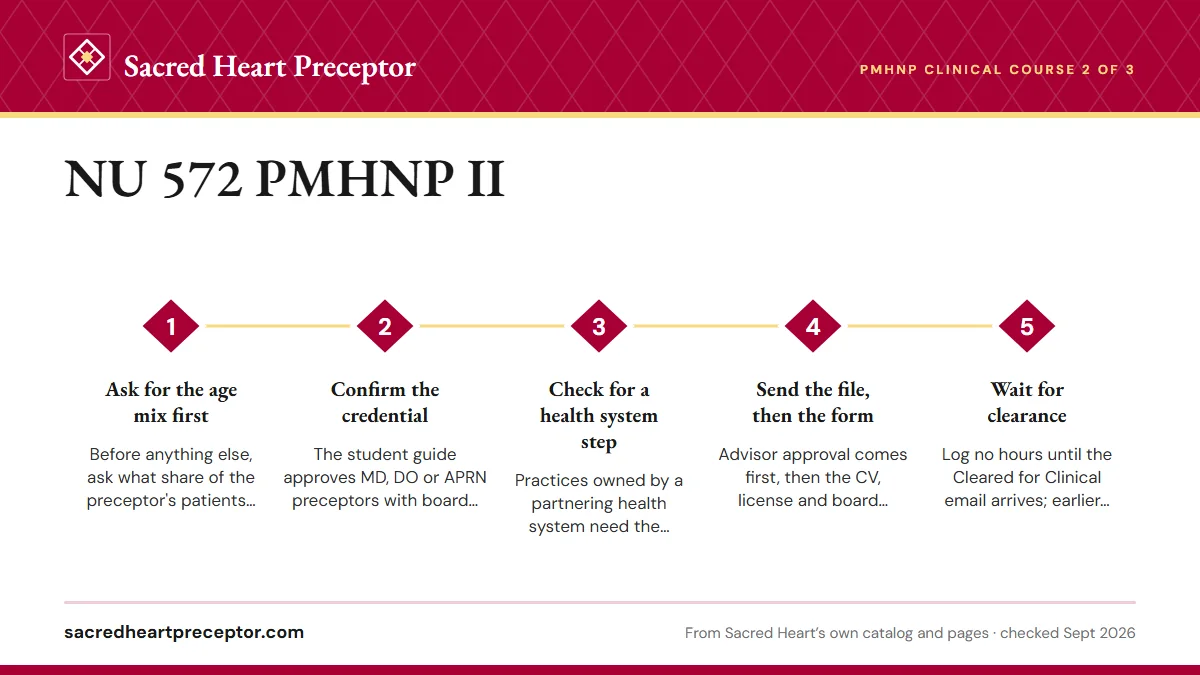
- Ask for the age mix firstBefore anything else, ask what share of the preceptor's patients are under 18. A practice that sees mostly adults may fall short of 100 hours in a single course.
- Confirm the credentialThe student guide approves MD, DO or APRN preceptors with board certification where appropriate. The inquiry form also recruits LCSWs and LMHCs, so check with your advisor before relying on one.
- Check for a health system stepPractices owned by a partnering health system need the system's sign-off before Sacred Heart's NP clinical coordinator can approve the preceptor.
- Send the file, then the formAdvisor approval comes first, then the CV, license and board certification go to the NP clinical coordinator, then the PMHNP Contract Request Form for your program.
- Wait for clearanceLog no hours until the Cleared for Clinical email arrives; earlier hours are deleted.
The preceptor approval page explains what reviewers look at in each file.
A strong adult psychiatry preceptor can still be the wrong NU 572 placement if too few patients are under 18.
Timing inside and around NU 572
The Clinical Placement Team publishes the PMHNP placement dates, and registration for NU 572 requires an approved site and preceptor. The search therefore belongs in the weeks of NU 571, or earlier if the site is new to Sacred Heart and needs an affiliation agreement. See the deadline page for how PMHNP dates differ from the FNP's week 10.
On the far side, NU 573 lists NU 571 rather than NU 572 among its catalog prerequisites, while the roman numerals and the SHU Online page present the courses as I, II and III. Confirm the order in your plan of study. The adult diagnostic and prescribing base from NU 571 carries into this course, and the family work and emergency management you practice here carry into NU 573, which covers couples, families and complex systems.
Why students choose us for NU 572
The under-18 requirement makes this the PMHNP placement where a general yes from a practice is not enough. We ask every candidate site for its pediatric and adolescent volume before presenting it, favor child and adolescent psychiatric preceptors in your own area, and prepare the complete credential file Sacred Heart reviews.
Start with us during NU 571 and your placement advisor can line up NU 572 while your adult hours are still underway. If the preceptor's pediatric schedule thins out mid-course, your placement advisor looks for a replacement child-focused preceptor right away, keeping the 100 hours within reach. Use the contact form to begin.
Questions Sacred Heart students ask
How many NU 572 hours must be with children?
At least 100 of the 180. The catalog states that a minimum of 100 hours of the clinical practicum is devoted to the care of patients under age 18. The rest of the course keeps a pediatric and adolescent emphasis, so a child-focused site serves the whole 180 hours well.
Does an 18-year-old patient count toward the 100 hours?
The catalog wording is patients under age 18, so an 18-year-old falls outside it. Those visits can still count toward the course's 180 total. For any borderline case, such as a patient who turns 18 during treatment, ask your course faculty how to log it.
What are the two titles for NU 572?
The catalog uses PMHNP II: Care of Children and Families. The SHU Online program page uses PMHNP II: The Psychiatric Nurse Practitioner's Role with Children and their Families. Credits, hours and the under-18 rule are the same under both names.
Can a school-based program be my NU 572 site?
It can fit. The catalog calls for a variety of behavioral health settings, and Sacred Heart's clinical affiliations page lists school health among its placement types. The preceptor still needs a credential the student guide accepts, and the site needs academic advisor approval and an affiliation agreement.
Is NU 572 part of the post-master's PMHNP certificate?
Yes. The certificate's 540 practicum hours sit in NU 571, NU 572 and NU 573, so certificate students meet the same 100-hour rule. The SHU Online page lists the certificate at 21 credits, with NU 509 before the three practicums.
Related pages
Last checked 2026-09-25
We check these pages against Sacred Heart's own catalog, program pages and 2026-27 student guides. Your student guide, your academic advisor and your course faculty have the final word.
Sacred Heart asks you to secure your clinical placement. We make that the easy part.
Tell us your Sacred Heart program, your city and your next clinical course. We find preceptors who fit the course and prepare what your advisor, the NP clinical coordinator and the Contract Request Form ask for, early enough for the affiliation agreement.
- Preceptors matched to the course: primary care of adults, women and children for FNP, psychiatric care across the lifespan for PMHNP
- Preceptor CV, license, board certification and the site's contract contact ready before your week-10 deadline
- Close to home in any state where Sacred Heart's program meets licensure requirements, with New York's rule planned around
Start your placement plan
Program, city and clinical start is all we need to begin.