Grades and progression in Sacred Heart's graduate nursing programs
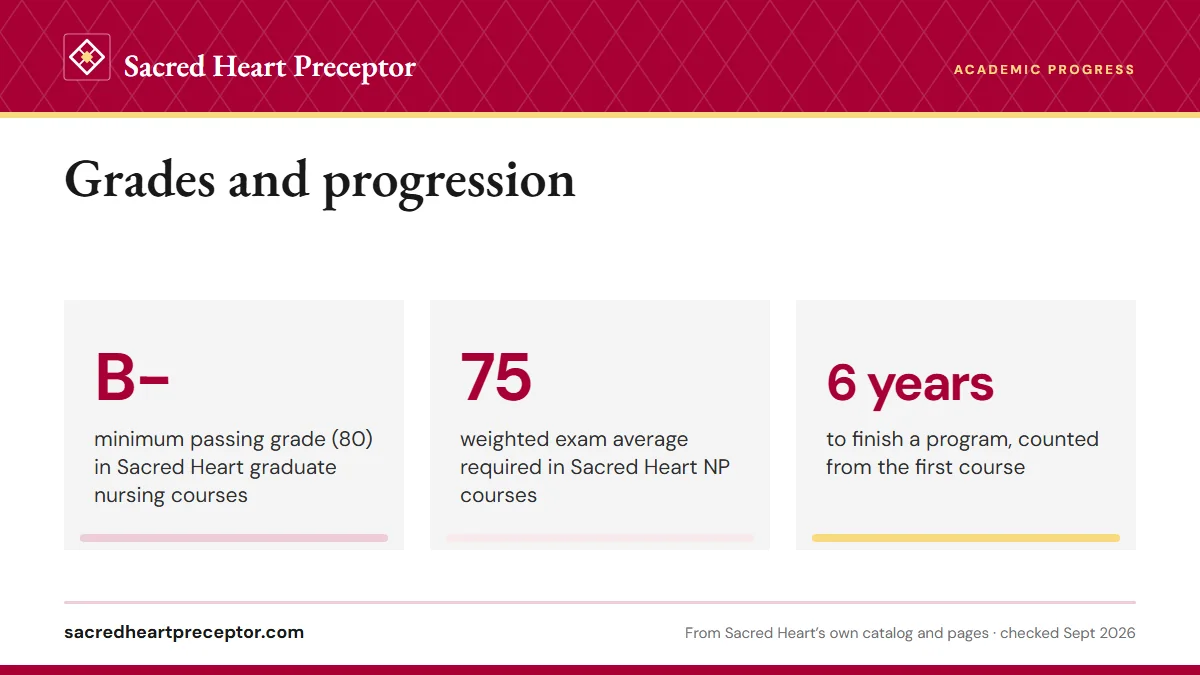
Sacred Heart University's online MSN and certificate courses pass at B- (80), NP courses also require a 75 weighted exam average, and a nursing course can be repeated once. Clinical work feeds the grade directly through the practicum, the residency and E*Value. Knowing these rules from the first term is the surest way to finish on schedule.
Keep your clinical course on track
A preceptor confirmed early leaves room for clearance, hours and evaluations to land on time.
The passing standard: B- and a 3.0
Sacred Heart's MSN and Post-MSN Certificate guide draws one line for every course: "The minimum passing course grade at the graduate level is a B-," which the guide also expresses as a numerical 80. Alongside it you hold a cumulative GPA of 3.0. The guide describes itself as the official student handbook and a supplement to the university catalog, so nursing students read both.
The catalog's graduate scale runs A, A-, B+, B, B-, C+, C and F, plus P, NP, W, I, AU and NG, which stay out of the GPA. University-wide, a cumulative GPA below 3.0 means academic probation, and a GPA below 2.7 after 18 attempted credits means dismissal from the university; departments may add requirements of their own.
Other programs set their own lines. The hybrid FNP/DNP and the post-master's DNP ask for B- or better in every required nursing course, a 3.0 GPA and no professional or clinical warnings. RN-BSN nursing courses pass at C+ (77), and the 500- and 600-level courses taken in the RN-BSN-MSN at B- (80).
The 75 exam average in NP courses
Eleven NP courses carry a second test: NU 566, NU 552, NU 551, NU 561, NU 606, NU 607, NU 621, NU 571, NU 572, NU 573 and NU 509. In each one, the weighted cumulative average of all exams has to reach 75.
Fall short, and the course grade becomes the exam average alone, with papers, discussions and projects set aside. An average from 73 to 76 is a C, and anything under 73 is an F, so a strong assignment record cannot carry a weak exam record over the line.
The fix is early attention. Work out your running exam average after each test, ask course faculty how exams are weighted if the syllabus leaves you unsure, and use the Center for Teaching and Learning, whose tutoring runs through the PASS Portal, while there are still exams left to lift the average.
How clinical work enters your grade
Clinical performance does not sit beside the course grade; it decides it. Sacred Heart's guides connect the two in four places:
- The practicum: "Failure of the clinical practicum will result in failure of the course." Passing it takes a course grade of at least 80, every clinical competency met and the full count of required hours.
- Clinical practice components: a failure is graded F, and the guide says the student will be dismissed from the program.
- Residencies: graded pass/fail, and a failed residency fails any clinical course; the residencies page shows which programs have them.
- E*Value: required documents submitted late bring a failure (F) in clinical; the E*Value guide lists them.
Hours logged while non-compliant, or at a site or with a preceptor that was never approved, are deleted and bring a program warning. Each of these risks is easy to manage with steady weekly habits, which is why they are worth learning early.
Late E*Value paperwork is graded like clinical performance: an evaluation filed after its due date can fail a course you were otherwise passing.
Repeating a course: once, and only from the C range
A nursing course can be repeated only once during your program, and only from certain grades. A final grade from 73 to 79 (C to C+) means the course must be repeated. Section 3.8 of the MSN guide asks for a B or higher on the retake, while section 3.9 speaks of a B- or better, so confirm the target with your advisor before the second attempt begins.
Below that range, a retake is off the table. The guide states that a student "receiving a grade of C- or F (below 73) will not be allowed to retake the course," and a grade under 73 leads to dismissal from the program.
The hybrid FNP/DNP frames it differently: a C+ or C may be repeated, and a second grade below B- in any nursing course brings a recommendation for dismissal. Either way, the time to act is the first sign of trouble in a course, not the final grade.
Warnings, probation and appeals
Sacred Heart uses written warnings before probation. Two consecutive warnings, or three that are not consecutive, place a student on nursing programmatic academic probation for two academic semesters or four enrolled modules. Probation brings a Student Success Plan and a limit of one course per module, a structure designed to get a student back on firm ground.
A dismissal can be appealed on three grounds: an arithmetic or clerical error, extenuating circumstances, or discrimination or harassment. The appeal is due by January 3 for a fall-semester dismissal and otherwise within 14 business days of the notice. The Academic Standards Committee hears it, and the Dean decides.
Problems inside a clinical rotation follow their own chain of command: the preceptor or course faculty first, then the Assistant Program Director or Program Director, the Chair of Graduate Programs, the Associate Dean and finally the Dean.
Withdrawals and incompletes
You may withdraw from up to two nursing courses during the program, and the Program Director may allow one more. The form comes from your Student Services Coordinator, and a W is recorded only inside the calendar deadline; the catalog is blunt that "Non-attendance does not constitute official withdrawal." Deadlines differ by calendar, so check the course calendar with your advisor.
An incomplete is possible only after the withdrawal date has passed, only while you are passing, and only with Program Director approval, recorded on an Incomplete Grade Agreement. The guide gives two deadlines for the unfinished work: six weeks from the end of the course (section 3.14) and the sixth week of the next full academic semester (section 3.5), which matches the catalog's timing. Past the deadline an I reverts to F, and an IX extension can be granted only once, with instructor and department-chair approval.
Leave, continuous enrollment and the six-year limit
A program leave of absence runs at least three consecutive modules or one semester and at most one year, and the request is due at least two weeks before the next course starts. The catalog's university leave speaks of returning within two years, so confirm with your advisor which limit applies to you. Going more than two consecutive modules, or a semester, without registering or an approved leave leads to administrative withdrawal and a readmission application.
Continuous enrollment is worded two ways: the catalog asks for enrollment in any two terms of the academic year, the guide for two courses within a 12-month period. FNP students who need more time for clinical hours can register for NU 600 Continuous Enrollment, a zero-credit course that keeps them enrolled while they finish.
Every program must be completed within six years of finishing the first course, and only the dean can extend that limit. Apply for graduation through SPA at least one semester before your final term.
Protecting your progress in clinical courses
Most clinical-course trouble starts before the course does: a preceptor confirmed late, a clearance email that arrives after the first week, or a preceptor who leaves halfway through. Each one squeezes hours and paperwork into fewer weeks, and that squeeze is where logs slip and evaluations go in late.
We take that pressure off before the course begins. We secure a well-matched preceptor near you early enough for approval and clearance to land on time, brief the preceptor on Sacred Heart's evaluation steps and E*Value timing, and start a replacement search at once if a preceptor steps away. If you are already short on hours, the behind on clinical hours page shows where we begin; for the full service, see how it works.
Questions Sacred Heart students ask
What is the passing grade in Sacred Heart's online MSN?
B-, which Sacred Heart's MSN guide equates with a numerical 80, in every MSN course, together with a cumulative GPA of 3.0. NP courses add a second condition: the weighted average of all exams must reach 75, or the course grade becomes the exam average. For comparison, RN-BSN nursing courses pass at C+ (77).
What happens if my exam average is below 75 in an NP course?
Your final grade is set by the exam average alone, without assignments or participation. An average of 73 to 76 is a C, which means repeating the course, and under 73 is an F, which cannot be retaken under the MSN guide. Check your running average after every exam and bring concerns to course faculty early.
Can I retake a failed nursing course at Sacred Heart?
Only a final grade from 73 to 79 (C to C+) can be retaken, and only once in the whole program. A grade of C- or F, meaning below 73, cannot be retaken under the MSN guide. In the hybrid FNP/DNP, a C or C+ may be repeated, but a second grade under B- leads to a dismissal recommendation.
How many nursing courses can I withdraw from?
Up to two over the program, plus one more if the Program Director approves it. Withdrawal uses a form from the Student Services Coordinator and must happen before the calendar deadline, and simply stopping attendance does not count. Ask your advisor how a withdrawal will shift your plan of study and your clinical sequence.
How long can a Sacred Heart nursing leave of absence last?
The nursing guide sets a minimum of three consecutive modules or one semester and a maximum of one year, and the request is due at least two weeks before your next course. Staying away longer than two consecutive modules without registering or an approved leave leads to administrative withdrawal and reapplication.
Related pages
Last checked 2026-09-25
We check these pages against Sacred Heart's own catalog, program pages and 2026-27 student guides. Your student guide, your academic advisor and your course faculty have the final word.
- Sacred Heart University, MSN and Post-MSN Certificate Online Programs Student Guide, 2026-2027
- Sacred Heart University, FNP/DNP Hybrid Nursing Program Student Guide, 2026-2027
- Sacred Heart University 2026-2027 Graduate Catalog, Grading System
- Sacred Heart University 2026-2027 Graduate Catalog, Academic Policies
- Sacred Heart University 2026-2027 Graduate Catalog, Academic Procedures
Sacred Heart asks you to secure your clinical placement. We make that the easy part.
Tell us your Sacred Heart program, your city and your next clinical course. We find preceptors who fit the course and prepare what your advisor, the NP clinical coordinator and the Contract Request Form ask for, early enough for the affiliation agreement.
- Preceptors matched to the course: primary care of adults, women and children for FNP, psychiatric care across the lifespan for PMHNP
- Preceptor CV, license, board certification and the site's contract contact ready before your week-10 deadline
- Close to home in any state where Sacred Heart's program meets licensure requirements, with New York's rule planned around
Start your placement plan
Program, city and clinical start is all we need to begin.