Sacred Heart University FNP/DNP clinical courses and placement
The hybrid BSN-to-DNP Family Nurse Practitioner program at Sacred Heart University runs six clinical courses. You arrange the NU 552 observation yourself, while NU 562, NU 622, NU 632, NU 831 and NU 832 go through the FNP/DNP Clinical Placement Coordinator ahead of each course. The student guide's table puts 615 clinical hours across the six, and a coordinator match, once you ask for one, is binding.
Get your placement plan
Tell us your Sacred Heart program and where you live. A placement advisor replies with the preceptor and site options that fit your course.
The six clinical courses
Titles, credits and prerequisites below come from the 2026-2027 catalog, hours from the 2026-27 FNP/DNP student guide, and terms from the full-time plan on sacredheart.edu.
| Course | Catalog title | Credits | Clinical hours | Full-time plan |
|---|---|---|---|---|
NU 552 | Advanced Health Assessment for NP | 3 | 8 to 10 observation hours (guide text); 15 in the guide table | Year 2 fall |
NU 562 | Primary Care I: Comprehensive Primary Care of the Adult | 5 | 120 | Year 2 spring |
NU 622 | Primary Care II for FNP/DNP | 6 | 180 | Year 3 fall |
NU 632 | Primary Care III for FNP/DNP | 7 | 180 | Year 3 spring |
NU 831 | Clinical Immersion I | 2 | 60 | Year 3 fall |
NU 832 | Clinical Immersion II | 2 | 60 | Year 3 spring |
The guide titles NU 632 "Primary Care III: Advanced Primary Care and Health Promotion of Special Populations." The web course-description page lists NU 622 as a spring course and NU 632 under an obsolete summer listing, while the full-time plan places them in the third-year fall and spring. Follow the plan of study for your cohort, including the four-year part-time version; the BSN-to-DNP program page has the full curriculum.
What each course asks of a site
The catalog calls NU 562 the first of three clinical courses, centered on the well adult with a required primary care clinical experience, so an adult or family primary care practice fits. NU 622 (prerequisite NU 562) moves to common and complex primary care problems in adult families and their members and the leadership side of the NP role. NU 632 (prerequisite NU 622) turns to special populations and emerging families through supervised clinical practice.
NU 831 Clinical Immersion I, which requires NU 823, and NU 832 Clinical Immersion II, which requires NU 831, are built around the clinical interests you bring, mixing specialty experiences, procedure workshops and preparation for the board exam.
In the full-time plan each immersion shares a term with a 180-hour primary care course, so the third year holds two placements at once: 240 clinical hours in the fall and 240 in the spring. Plan both searches together.
NU 552: the one you arrange yourself
The first clinical course is the exception to coordinator arrangement. You line up 8 to 10 hours observing an NP, a physician or a PA at physical assessment, at a site with an active affiliation agreement. As an independent placement it needs sign-off from the Program Director and course faculty plus an executed contract, and compliance is due 30 days ahead of the course's first day. The NU 552 page walks through each step.
Use those observation hours to start building the network the guide expects of you later. The clinicians you meet in NU 552 are exactly the kind of colleagues worth raising with the Clinical Placement Coordinator when NU 562 comes up.
How the Clinical Placement Coordinator works
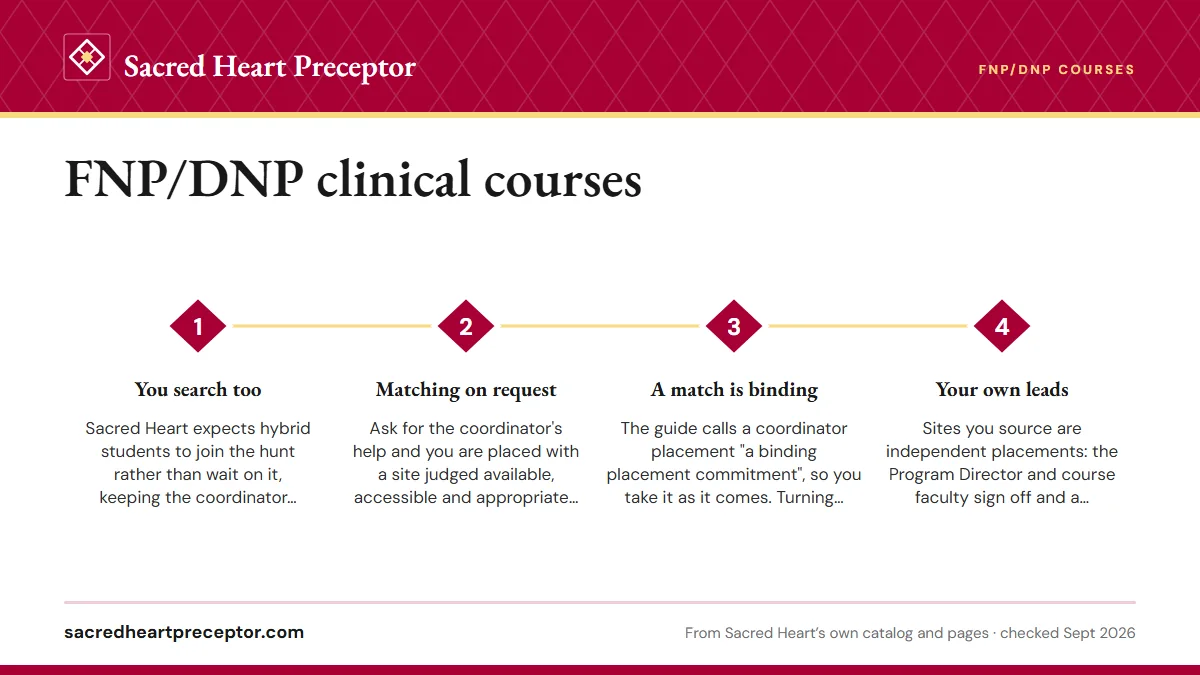
Every course after NU 552 runs through the FNP/DNP Clinical Placement Coordinator. Under the guide, the site and its approved preceptor are arranged with the coordinator, on the Program Director's terms, before the course opens. In practice that works in four parts:
- You search tooSacred Heart expects hybrid students to join the hunt rather than wait on it, keeping the coordinator informed about the rotations ahead. The guide also points you to your own network: colleagues past and present, co-workers, friends and family.
- Matching on requestAsk for the coordinator's help and you are placed with a site judged available, accessible and appropriate. That can mean any part of Connecticut, New Jersey or another neighboring state connected to where you live or hold a license; New York is excluded.
- A match is bindingThe guide calls a coordinator placement "a binding placement commitment", so you take it as it comes. Turning it down requires a reason the guide describes as extensive and legitimate, and finding a site then becomes your job, subject to Program Director approval.
- Your own leadsSites you source are independent placements: the Program Director and course faculty sign off and a contract is executed before day one. Replacement rotations still answer to the semester's placement deadlines, and missing one can end a tentative placement.
Decide before you ask. Once you request a coordinator match you are committed to the placement you are given, so raise any site you already have in mind with the coordinator first.
Semester dates and the rules on hours
The guide draws a hard line around each term: "Clinical hours cannot be completed before the semester start date & must be finished by the semester end date." The hybrid program runs on the registrar's semester calendar, with 2026-27 terms starting August 31, January 19, May 24 and July 7, so time between terms adds nothing to your log.
Other rules shape what counts. A Zoom class, however clinical its topic, never adds to your hours. A background check and drug screen come before clinical, and the CHA Health & Safety Test before your first course, and no hour counts until your clearance email arrives; the Cleared for Clinical page explains it. Students are expected at every 8-hour intensive day on campus and every clinical experience.
E*Value carries more here than in the online programs: clinical and practice hour logs, SOAP notes, a Clinical Advisor Site Visit/SOAP Note Feedback Evaluation and a description of each clinical site. The E*Value page covers the system.
How these hours feed the DNP total
The six courses carry 615 clinical hours in the guide's table, against the guide's stated minimum of 500 clinical hours, 500 practice hours and 1,000 in total after the bachelor's degree. The catalog's lower 435-hour practice figure is a separate conflict, worked through on the DNP 1,000-hour page.
Preceptor types read differently across sources: an older FNP/DNP compliance update says an NP, MD or PA, while the APRN preceptor portal accepts an MD, DO, PA or APRN licensed where they practice, and wants physicians and APRNs board certified. That older update also spoke only of placements anywhere in Connecticut, where the 2026-27 guide reaches into New Jersey and neighboring states. New York stays off the map for every NP clinical hour, as the New York rule page explains.
How we support hybrid FNP/DNP students
The guide asks you to search and network alongside the coordinator, and that is the work Sacred Heart's hybrid students hand to us. We build preceptor leads across Connecticut, New Jersey and neighboring states outside New York, each profiled for its course: adult primary care for NU 562, complex adult families for NU 622, special populations for NU 632, and your specialty interest for the immersions.
We gather each preceptor's CV, license and board certification and the site's contract contact, so a lead you bring to the Clinical Placement Coordinator is ready to evaluate, and we find the NU 552 observation host too. If a rotation falls through mid-term, we start on a replacement at once with the semester's placement deadlines in view. Sacred Heart and its coordinator approve every placement; our job is a complete, well-matched lead. Use the form below to start.
Questions Sacred Heart students ask
Do I have to go through the Clinical Placement Coordinator for every FNP/DNP course?
Yes, for everything after NU 552. The coordinator takes part in arranging each later course's site and preceptor, even when the lead comes from you, and a site you find still counts as an independent placement needing Program Director and course faculty approval and an executed contract. Only the NU 552 observation is left entirely to you.
Can I do FNP/DNP clinical hours outside Connecticut?
Yes, within limits. The 2026-27 guide says matched placements can land in any part of Connecticut, in New Jersey, or in a neighboring state linked to your residence or licensure, never New York. Because matches follow residence and licensure, hold an active RN license in any state where you would train, and talk with the coordinator before accepting a site across a state line.
Can I start NU 562 hours over winter break?
No. Hours before the semester start date do not count, and the hybrid program's 2026-27 spring semester begins January 19, 2027. Hours also need your clearance email, an approved preceptor and an affiliation agreement in place. Use the break to finish paperwork and compliance so you can start logging in the first week of the term.
Is the Sacred Heart FNP/DNP program online or hybrid?
Hybrid. The catalog calls it a blended program of online and on-campus classes, sacredheart.edu describes an average of six on-campus classes per semester, and the student guide sets intensive days at 8 hours. The preceptor portal's Clinical Course Information page labels it FNP-DNP Online, but the program page, catalog and guides all describe it as hybrid.
Related pages
Last checked 2026-09-25
We check these pages against Sacred Heart's own catalog, program pages and 2026-27 student guides. Your student guide, your academic advisor and your course faculty have the final word.
- Sacred Heart University FNP/DNP Hybrid Nursing Program Student Guide, 2026-2027
- Sacred Heart University 2026-2027 Graduate Catalog: Post-Baccalaureate to DNP (FNP)
- Sacred Heart University: DNP Family Nurse Practitioner curriculum
- Sacred Heart University Registrar: Graduate semester-level programs calendar 2026-2027
- Sacred Heart University Preceptor Portal: APRN Programs
Sacred Heart asks you to secure your clinical placement. We make that the easy part.
Tell us your Sacred Heart program, your city and your next clinical course. We find preceptors who fit the course and prepare what your advisor, the NP clinical coordinator and the Contract Request Form ask for, early enough for the affiliation agreement.
- Preceptors matched to the course: primary care of adults, women and children for FNP, psychiatric care across the lifespan for PMHNP
- Preceptor CV, license, board certification and the site's contract contact ready before your week-10 deadline
- Close to home in any state where Sacred Heart's program meets licensure requirements, with New York's rule planned around
Start your placement plan
Program, city and clinical start is all we need to begin.