Sacred Heart University RN-to-BSN-to-MSN: clinical hours at each stage
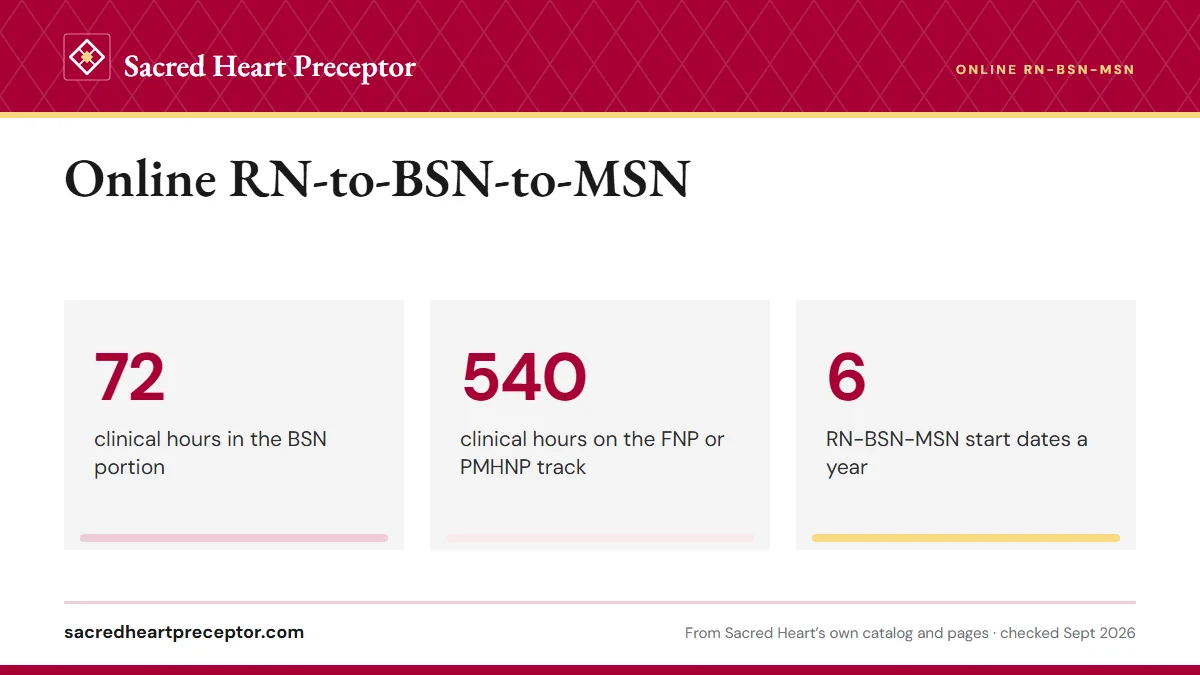
Sacred Heart University's online RN-to-BSN-to-MSN has two clinical stages: 72 hours in the BSN portion, then the full clinical load of the MSN track you choose, from 120 hours in NMEL to 540 in the nurse practitioner tracks. Sacred Heart's own sources disagree on which tracks are open, which bridge course you take and whether there is a residency. We plan preceptors for both stages so the graduate search is under way before the BSN practicum ends.
Plan both clinical stages
Tell us your MSN track and where you are in the program.
How the bridge program is built
The graduate catalog calls it the Accelerated RN-to-BSN-to-MSN Program. You begin in the online RN-to-BSN coursework, and a set of graduate courses stands in for some BSN credits, so part of the master's is done before the bachelor's is conferred. SHU Online lists 51 to 153 credit hours depending on transfer credit and track, a typical length of 3.5 years, and up to six years to finish.
Admission GPA depends on the MSN track you name: 3.2 for FNP or PMHNP, and 3.0 for CNL, NE or NMEL (2.8 under the Connecticut Articulation Agreement). After admission you keep a 3.0. SHU Online's FAQ lists six start dates a year.
The BSN stage includes NU 315, NU 325, NU 376 and NU 387. Graduate courses replace other BSN requirements: NU 501, NU 530, NU 601 and NU 602 for every track, with one more course that depends on the track and on which Sacred Heart source you read (see the conflicts below).
Clinical hours by stage and track
SHU Online's FAQ frames it in two parts: 72 clinical hours for the BSN portion, then the hours of your MSN track. The table pairs those figures with the course numbers in the catalog and the MSN student guide.
| Stage or track | Clinical courses | Hours | Rules come from |
|---|---|---|---|
| BSN portion, every student | NU 376, NU 387 | 72 | RN-BSN student guide |
| Clinical Nurse Leader | NU 611, NU 612, NU 680, NU 681 | 420 (the catalog says 400 or 500) | MSN student guide |
| Nursing Education | NU 619, NU 690, NU 691 | 180 | MSN student guide |
| Nursing Management & Executive Leadership | NU 672, NU 673 | 120 | MSN student guide |
| Family Nurse Practitioner | NU 561, NU 606, NU 607, NU 621 | 540 | MSN student guide |
| Psychiatric-Mental Health NP | NU 571, NU 572, NU 573 | 540 | MSN student guide |
No Sacred Heart source says BSN hours count toward the MSN figure, so plan for both in full. Track detail lives on the FNP and PMHNP pages and on the pages for each leadership and education track.
Stage one: the BSN practicum
The BSN portion runs on the RN-BSN rules, and the RN-BSN student guide covers both programs in one section. Preceptors and organizations are due nine months before your first clinical course; each choice needs advisor sign-off on a CV and RN license before the Contract Request Form goes in. Training inside the institution that employs you is allowed, though never on your own unit or clinic.
NU 376 covers care transitions from hospital to community and a family assessment, and NU 387 turns to populations and global health. Both are eight weeks. The full walk-through is on the RN-to-BSN page, and the nine-month rule sits beside the MSN deadlines on the deadlines page.
This stage is non-licensure, so Sacred Heart's State Authorizations page lets its preceptorships happen in New York agencies. That changes once an FNP or PMHNP student reaches the graduate clinical courses.
Stage two: the MSN track's placements
At the graduate clinical courses, the MSN student guide takes over and the process splits by track. CNL, NE and NMEL students route a CV and RN license for each preceptor through the academic advisor, meet the Clinical Placement Team's published deadline and finish compliance two weeks before each clinical course, which runs eight weeks.
FNP and PMHNP students face a longer chain. Preceptors must be MD, DO or APRN (PA is also accepted for FNP), with board certification where appropriate, and after advisor approval their documents go to the MSN Online NP Programs Clinical Coordinator. FNP placements are due in week 10 of the course before each clinical course, NP courses run 16 weeks, and registration for a clinical course needs an approved site and preceptor first. The approval chain is laid out on preceptor approval.
New York also closes for NP clinical hours: New York residents train in a neighboring state and hold an RN license there (New York rule).
Where Sacred Heart's sources disagree
Three points in the bridge program depend on which Sacred Heart document you open. Settle each with your academic advisor before you register for the graduate substitutes.
- Which tracks are open. The graduate catalog and section 1.4 of the MSN guide list the RN-to-MSN for NMEL, Nursing Education and CNL only. The undergraduate catalog and SHU Online list all five tracks, FNP and PMHNP included.
NU 335orNU 575. The undergraduate catalog has FNP and PMHNP students takeNU 335and CNL, NE and NMEL students takeNU 575. SHU Online's curriculum page reverses the pairing.- Residency. SHU Online's FAQ says the RN-BSN-MSN has no residencies. The RN-MSN program page says FNP and PMHNP students also complete an on-campus residency, which matches the residencies built into the MSN NP tracks.
Ask for your plan of study in writing and keep it with your clinical planning. It decides your course sequence, and the sequence decides when each preceptor search has to start.
Confirm your track is actually offered through the bridge before you plan graduate clinicals: two Sacred Heart sources list only CNL, NE and NMEL.
Why bridge students choose us
The RN-BSN-MSN is two placement projects back to back, and the graduate one usually carries more hours and more paperwork. Your placement advisor secures the two BSN practicum placements away from your home unit, then opens the MSN search early enough for a new affiliation agreement to clear before your first graduate clinical course.
For NP-track students that means preceptors with the right license and board certification, in a state where you hold an RN license, outside New York, with the documents the NP clinical coordinator reviews. For CNL, NE and NMEL students it means leaders and educators whose organizations will contract with Sacred Heart. Sacred Heart approves each preceptor and site; we deliver files it can act on right away. Start on the contact page.
Questions Sacred Heart students ask
How often does the RN-to-BSN-to-MSN start?
SHU Online's FAQ lists six start dates a year for the RN-BSN-MSN, which gives you flexibility for the BSN stage. The direct-entry MSN nurse practitioner tracks start once a year in the fall, so ask your academic advisor how your graduate clinical courses will line up with your start date before you plan any preceptor search.
Can I do the BSN clinical hours in New York and the NP hours elsewhere?
That split fits Sacred Heart's rules. The State Authorizations page lets RN-BSN preceptorships take place in New York agencies, while no NP clinical hours may happen in New York. A New York resident on the FNP or PMHNP track would complete the graduate hours in a neighboring state and hold an RN license in that state.
Do I take NU 335 or NU 575 in the bridge?
It depends on which Sacred Heart source you follow, and they disagree. The undergraduate catalog assigns NU 335 to FNP and PMHNP students and NU 575 to CNL, NE and NMEL students; SHU Online's curriculum page reverses it. Neither course lists clinical hours, but the choice changes your plan of study, so have your academic advisor confirm it.
When should I start looking for my MSN preceptor?
While you are still in the BSN stage. Contracting an organization Sacred Heart has never used may stretch to nine months, FNP placements are due in week 10 of the course before each clinical course, and CNL, NE and NMEL deadlines come from the Clinical Placement Team. Beginning the graduate search around NU 387, or sooner, leaves room for all of it.
Do the 72 BSN hours count toward my MSN hours?
No Sacred Heart source says they do. SHU Online's FAQ presents the 72 BSN hours and the MSN track's hours as separate requirements, so plan for both in full. If you hope to count any experience twice, ask your academic advisor for a written answer before you schedule preceptor time around it.
Related pages
Last checked 2026-09-25
We check these pages against Sacred Heart's own catalog, program pages and 2026-27 student guides. Your student guide, your academic advisor and your course faculty have the final word.
- Sacred Heart University 2026-27 Graduate Catalog: RN-to-BSN-to-MSN Program
- Sacred Heart University 2026-27 Undergraduate Catalog: Nursing Completion Programs (RN-BSN, RN-BSN-MSN)
- Sacred Heart University RN-BSN and RN-BSN-MSN Student Guide, 2026-27
- Sacred Heart University Online: RN to BSN to MSN
- Sacred Heart University Online: FAQ
Sacred Heart asks you to secure your clinical placement. We make that the easy part.
Tell us your Sacred Heart program, your city and your next clinical course. We find preceptors who fit the course and prepare what your advisor, the NP clinical coordinator and the Contract Request Form ask for, early enough for the affiliation agreement.
- Preceptors matched to the course: primary care of adults, women and children for FNP, psychiatric care across the lifespan for PMHNP
- Preceptor CV, license, board certification and the site's contract contact ready before your week-10 deadline
- Close to home in any state where Sacred Heart's program meets licensure requirements, with New York's rule planned around
Start your placement plan
Program, city and clinical start is all we need to begin.